



Introduction
Vyzor – Inertia, React, and Laravel Premium Admin & Dashboard Template for All Your Web Projects
Vyzor – Inertia, React, and Laravel Premium Admin & Dashboard Template
that combines modern and minimal design with full flexibility
and responsiveness. It’s crafted using
React , Inertia.js , Laravel , CSS3 ,
and React-Bootstrap offering seamless customization with
SASS
integration. Whether you’re building a web application, admin dashboard, or
project management platform, this template ensures your site stands out with
ease.
Support and Updates:
When you purchase Vyzor, you gain access to free future updates to ensure your template remains up-to-date. Plus, our support team is always ready to assist with any questions.
What Do You Get with the Vyzor:
Vyzor provides all necessary PHP,React, CSS, SCSS, Jsx files, along with detailed Documentation to help you easily customize and implement the template.
Vyzor Compatibility with Popular Browsers:
Vyzor is fully compatible with major browsers, ensuring a seamless user experience across Chrome, Firefox, Safari, Edge, and Opera.
Getting Start Guide
Setting Up The Local Environment & Workspace
This comprehensive guide provides step-by-step instructions on how to set up your development environment for Vite using the React,Laravel tool. It covers everything from the necessary prerequisites to installing the tool, creating an initial workspace, and setting up a starter app. You'll also learn how to run the app locally to test and verify your setup. By following this guide, you can ensure that your development environment is properly configured for Vite and React, and you can get started with your project confidently and efficiently. Whether you're a beginner or an experienced developer, this guide is an essential resource for anyone looking to work with Vite and React.
To get started with a React application, there are some prerequisites that you need to have in place.
Prerequisites
For installation and setup all prerequisites, you should be familiar with the following:- Xampp
- Composer
- React
- vite
- React Bootstrap
- Javascript
To install vite on your local System, you need the following:
Node.JS
vite requires a current, active LTS (long term support) or maintenance LTS (long term support) version of Node.js.
Download latest version of node.js from nodejs.org.Install Node.js using downloaded file.
To check your node version, run node -v in a terminal/console window (cmd)
Npm package Manager
The vite and React applications depend on npm packages for many
features and functions.
To download and install npm packages, you need an npm package manager.
This guide uses the npm client command line interface, which is installed
with Node.js by default. To check that you have the npm client installed,run
npm -v in a terminal/console window (cmd)
For better understanding React we suggest you once go through official
documentation of React from React
Documentation and vite for Vite
documentation
Installation Process
Installation Process of Composer
In order to run Laravel we need to install composer by the following steps
Steps to Download & Installation of Composer
Step1: Please visit the Official Web Site of the Composer www.getcomposer.org
Step2: Click on the Download option
Step3: Click on the Composer-Setup.exe you are done with download
Step4: Now Right click on the Composer-Setup.exe file and select Run as administrator click on Yes
Step5: You'll be getting two options click as per your choice
Step6: I choose Recommended option here and if your developer you can check the box of the Developer Mode
Step7: And click on the Next button please make sure of installation path and then click Next
Step8: You'll be asked to enter proxy url please skip the step and click on the Next button
Step9: Please make sure with the PHP Version it should not be less than 8.2v, here we used 8.2.12 Version and then click on the next button
Step10: To confirm that Composer is installed in your system then type Composer in command prompt (if you are using XAMPP then go to C:\xampp\htdocs location and type composer)
How to Run the Vyzor Template:
If you have installed XAMPP on your machine then please follow the below steps
Step:1 Quick view of Installations
1. Download and Install the Composer from official site https://getcomposer.org/
2. Install Laravel by using Composer as mentioned in the installation process above.
Step:2 Run project
1. Extract the zip folder of the laravel project in the path: EX: C:\xampp\htdocs\ that you have received after purchase.
2. Once the extraction is completed for accessing the laravel project, open command prompt or terminal and set your project root path: Example: C:\xampp\htdocs\
3. Open the terminal and set the root path of your template and then run the following command: "composer install" only if it is required to update your "vendor" directory.
4. Now run the below commands in the terminal to get the output of the project. To get the node_modules install.
To get the node_modules install.
code
npm install to get the build assets of the project.
code
npm run build And run the command line:
code
npm run dev code
php artisan serve Laravel development server started: http://127.0.0.1:8000, now type
the url in the browser to access the project.
Installation Video
InertiaJS
Inertia Setup Guidance
Inertia.js acts as a bridge between your Laravel backend and React frontend, allowing you to build modern SPAs without the complexity of managing APIs or client-side routing manually.
1.Server-side Setup:
The first step when installing Inertia is to configure your server-side framework. Inertia maintains an official server-side adapter for Laravel.
The setup includes Laravel’s powerful routing system and controllers, with Inertia’s Laravel adapter responsible for returning views as React components instead of traditional Blade templates. This allows developers to write backend logic in Laravel as usual, while seamlessly passing data to React components via Inertia.
First, install the Inertia server-side adapter using the Composer package manager.
code
composer require inertiajs/inertia-laravel Next, set up the root Blade template that will be used when a user first visits your application. This template is responsible for loading your CSS and JavaScript assets, and it must include a root where your JavaScript frontend (React via Inertia) will be mounted.
<!DOCTYPE html>
<html lang="en">
    <head>
    <meta charset="UTF-8">
    <meta name="viewport" content="width=device-width, initial-scale=1.0">
    <title inertia>Vyzor - Inertia + Vue & Laravel Admin & Dashboard Template

    <!-- App favicon -->
    <link rel="shortcut icon" href="{{ URL::asset('favicon.ico') }}">

    <!-- ICONS CSS -->
    <link href="{{asset('build/assets/icon-fonts/icons.css')}}" rel="stylesheet">
    <!-- @routes -->
    @viteReactRefresh
    @vite(['resources/js/app.jsx'])
    @inertiaHead
    </head>
    <body>
    @inertia
    </body>
</html>
2.Client-side Setup:
Once you have your server-side framework configured, you then need to setup your client-side framework. Inertia currently provides support for React, Vue, and Svelte..
First, install the Inertia client-side adapter corresponding to your framework of choice.
code
npm install @inertiajs/react
Initialize the Inertia app
Next, update your main JavaScript file to boot your Inertia app. To accomplish this, we'll initialize the client-side framework with the base Inertia component.
code
import './bootstrap';
import '../scss/app.scss';
import { createInertiaApp } from '@inertiajs/react'
import { createRoot } from 'react-dom/client'
import RootWrapper from './Layouts/Rootwrapper';
import '../../resources/js/assets/scss/switcher.scss'
createInertiaApp({
    resolve: name => {
        const pages = import.meta.glob('./Pages/**/*.jsx', { eager: true })
        return pages[`./Pages/${name}.jsx`]
    },
    setup({ el, App, props }) {
        createRoot(el).render(
            <RootWrapper >
                 <App {...props} />
            </RootWrapper>
        )
    },
})
Vyzor - File Generate
How to Create a New Page
To create a new page in a Laravel + Inertia.js + React application, start by
adding a new React component inside the
resources/js/Pages directory—for example,
Newpage.jsx.
This file will contain the structure and content of your new page using JSX.
Next, define a corresponding route in Laravel’s routes/web.php file using
the
Inertia::render() method, which connects the URL path to the React
component.
Once the route is set, visiting that URL in the browser will render your new
React page. Optionally, you can integrate the new page into your navigation
menu
using the Inertia Link component and wrap it in a layout component for a
consistent UI.
Note:
If your are using "npm install", You should need to delete the "package-lock.json file" from project root.
To install the peer Depencies
In general, the npm i command is used to install all dependencies or devDependencies from a package. However, sometimes you may encounter errors while installing certain dependencies. In such cases, the --force argument can be used to force npm to install those dependencies.
Using the --force argument can be helpful when you need to install a specific dependency that is causing issues during installation. However, it should be used with caution, as it can potentially cause conflicts with other dependencies or lead to unexpected behavior. It's always a good idea to thoroughly test your application after using the --force argument to ensure that everything is working as expected.
code
npm install --forceSkipping the installation of peer dependencies can sometimes lead to issues with the functionality or compatibility of the package. To ensure that your package functions correctly, it's important to manually install any missing peer dependencies using the npm install command. When installing peer dependencies, you should also be aware of the potential for conflicts with other packages or dependencies. It's a good idea to carefully review the peer dependencies required by each package and ensure that they are compatible with other packages in your project. By taking these steps, you can avoid potential issues and ensure that your packages are installed and functioning correctly.
code
npm install--legacy-peer-depsWe have to use only one file example: (for yarn yarn-lock) & (for npm package-lock.json) file
For Build your Template
Build your application for host on server using below command:
code
npm run build
"Similarly, the starter kit can be installed as well."
Folder Structure
StaterKit Guide
Introduction to the Vyzor Template Starter Kit:
The Vyzor template starter kit is a resource that helps developers kickstart their Vyzor web development projects by providing a preconfigured and ready-to-use template. It aims to simplify the initial setup and provide a foundation for building Inertia + React & Laravel-based websites or applications.
Purpose of the Vyzor Template Starter Kit:
The purpose of the Vyzor template starter kit is to save developers time and effort by offering a set of prebuilt files and configurations commonly used in Vyzor projects. Instead of starting from scratch, developers can leverage the starter kit to quickly set up a project structure that adheres to best practices and industry standards.
Benefits of Using the Vyzor Template Starter Kit:
The starter kit eliminates the need to set up the basic project structure
manually. It provides a well-organized file and folder structure, including
commonly used directories for separating code, templates, assets, and
configuration files. This allows developers to focus more on implementing
business logic rather than spending time on initial setup.
Before using the Vyzor template starter kit, developers should have a basic
understanding of Inertia + React & Laravel and web development concepts.
Additionally, they should have a web server environment Laravel + React &
Inertia installed on their local machines or a hosting server.
Familiarity
with React, CSS, and JavaScript is also beneficial for frontend development
aspects.
Starterkit Overview
You can use the Starterkit if you are creating a new project. It will be time-consuming to use the full admin version for a new project as Vyzor have more than 180 pages.
We have provided all the pre-build layouts like Sidemenu, Header, Footer and Scripts etc in the Starterkit.
For further information or support regarding the template, please contact us using the provided link:https://support.spruko.com/
- Take a look at the folder structure of the "Starterkit."
- Integration of your customized .jsx pages becomes easy when using the "Starterkit."
- The "Starterkit" provides all the layout components and related assets.
- To explore the contents of the "Starterkit," unzip the project folder received after purchase. Navigate to the following paths:
- Example: resources/js/Layouts - This folder contains files such as authenticationlayout.jsx, landinglayout.jsx ,etc.
- Example: resources/js/Pages/new folder create - Add your js.x pages here if you have more.
Main Layout
Basic Layout Structure
Main Layout structure of the Vyzor template
.Root:resources\js\Layouts\layout.jsx
React
   import { Fragment, useEffect, useRef, useState } from "react"
   import Footer from "../shared/layouts-components/footer/footer";
   import Header from "../shared/layouts-components/header/header";
   import Sidebar from "../shared/layouts-components/sidebar/sidebar";
   import { Initialload } from "../contextapi"
   import { data$, getState } from "../shared/layouts-components/services/switcherServices"
   import Backtotop from "../shared/layouts-components/backtotop/backtotop";
   function RootLayout ( {children}) {

        const [lateLoad, setlateLoad] = useState(false);
        const progressRef = useRef(null);

        const [pageloading, setpageloading] = useState(false)

        useEffect(() => {
            setlateLoad(true);
            const handleScroll = () => {
                const scrollTop = document.documentElement.scrollTop || document.body.scrollTop;
                const scrollHeight = document.documentElement.scrollHeight - document.documentElement.clientHeight;
                const scrollPercent = (scrollTop / scrollHeight) * 100;

                if (progressRef.current) {
                    progressRef.current.style.width = `${scrollPercent}%`;
                }
            };

            window.addEventListener('scroll', handleScroll);
            return () => window.removeEventListener('scroll', handleScroll);
        }, []);

        let [variable, setVariable] = useState(getState());
        useEffect(() => {
          const subscription = data$.subscribe((e) => {
            setVariable(e);
          });

          return () => subscription.unsubscribe();
        }, []);
        useEffect(() => {
            setlateLoad(true);
        }, []);
        let containerclass = variable.dataPageStyle === 'flat' ? "main-body-container" : ""
        return (
        <>
          <Fragment>
            <Initialload.Provider value={{ pageloading, setpageloading }}>
                <div style={{ display: `${lateLoad ? "block" : "none"}` }}>
                <div ref={progressRef} className="progress-top-bar"></div>
                  <div className='page'>
                    <Header />
                    <Sidebar />
                    <div className='main-content app-content'>
                      <div className={`container-fluid page-container ${containerclass}`}>
                        <children />
                      </div>
                    </div>
                    <Footer />
                  </div>
                  <Backtotop />
                </div>
            </Initialload.Provider>
          </Fragment>
        </>
       )
    }

    export default RootLayout
React File Structure
General React file structure of the Vyzor template
.resources\js\Pages\pages\empty\empty.jsx
React
    import React, { Fragment } from "react";
    import { Card, Col, Row } from "react-bootstrap";
    import Seo from "../../../shared/layouts-components/seo/seo";
    import Pageheader from "../../../shared/layouts-components/pageheader/pageheader";
    import MainLayout from "@/Layouts/layout";
    const Empty = () => {
        return (
            <Fragment>
                <!-- Page Header -->
                    <Seo title="Pages-Empty" />
                    <Pageheader title="Pages"  currentpage="Empty" activepage="Empty" />
                <!-- Page Header Close -->

                <!-- Start::row-1 -->
                    <Row>
                        <Col xl={12}>
                            <Card className="custom-card">
                                <Card.Body>
                                    <h6 className="mb-0">Empty Card</h6>
                                </Card.Body>
                            </Card>
                        </Col>
                    </Row>
                <!-- End::row-1 -->
            </Fragment>
        )
    };
    // Assign layout
    Empty.layout = (page) => <MainLayout>{page}</MainLayout>;
    export default Empty;
Routing
Routing
In a single-page application, you change what the user sees by showing or hiding portions of the display that correspond to particular components, rather than going out to the server to get a new page. As users perform application tasks, they need to move between the different views that you have defined. To handle the navigation from one view to the next, you use the Laravel Router. The Router enables navigation by interpreting a browser URL as an instruction to change the view. Your complete route structure is place at web.php file under routes\web.php Suppose you want to create a new module ( For creating a new module refer create new module ) then you have to add new routes for that modules.
Basic Route
Following are the fundamental building blocks to creating a route
web.php
code
    Route::get('', function () {
        return Inertia::render('Login'); // your React component
    });
    Route::get('dashboards/sales', function () {
        return Inertia::render('dashboards/sale/sale'); // your React component
    });
    Route::get('dashboards/analytics', function () {
        return Inertia::render('dashboards/analytics/analytics'); // your React component
    });
    Route::get('dashboards/ecommerce/dashboard', function () {
        return Inertia::render('dashboards/ecommerce/dashboard/dashboard');
    });
    .......etc.
Configure Link in Menu
To Add new link in Sidemenu
Following are the fundamental building blocks to creating a new link.
code
    ├── src
    ├──components
    ├──common
    ├──sidebar
            ├── nav.jsx
                export const MENUITEMS = [
                {
                    menutitle: 'MAIN'
                },
                {
                    title: "Dashboards", icon: Svgicons.Dashboardicon, type: "sub", active: false, dirchange: false, children: [

                       { path: `${import.meta.env.BASE_URL}dashboards/sales`, icon: Svgicons.Salesicon, type: "link", active: false, selected: false, dirchange: false, title: "Sales" },
                        { path: `${import.meta.env.BASE_URL}dashboards/analytics`, icon: Svgicons.Analyticsicon, type: "link", active: false, selected: false, dirchange: false, title: "Analytics" },

                    {......}
                    ]
                }
              ]
Firebase Authentication Guide
Firebase SetUp
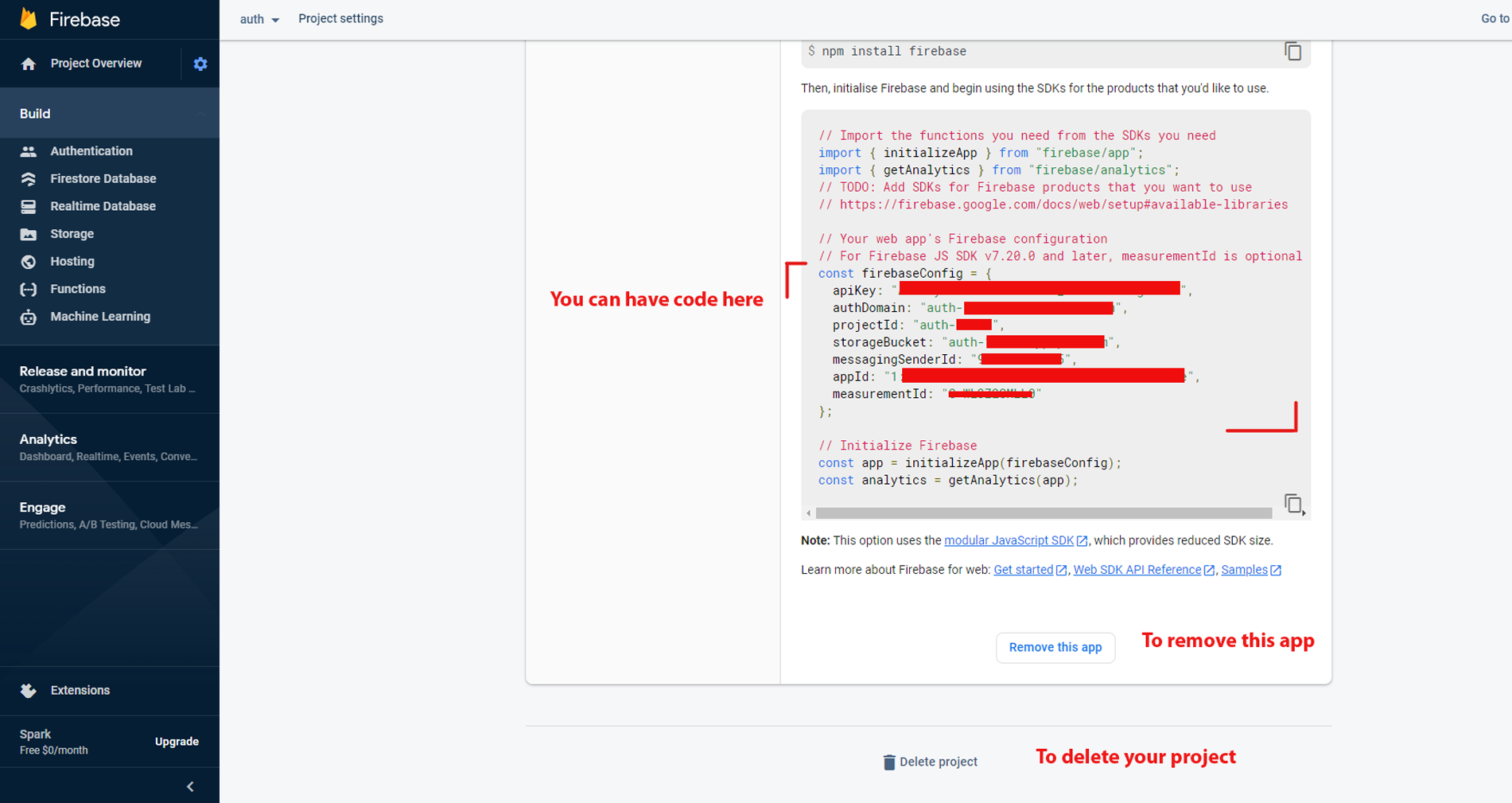
Step-1: Now run below commands inside our Vyzor project to install firebase latest.
bash
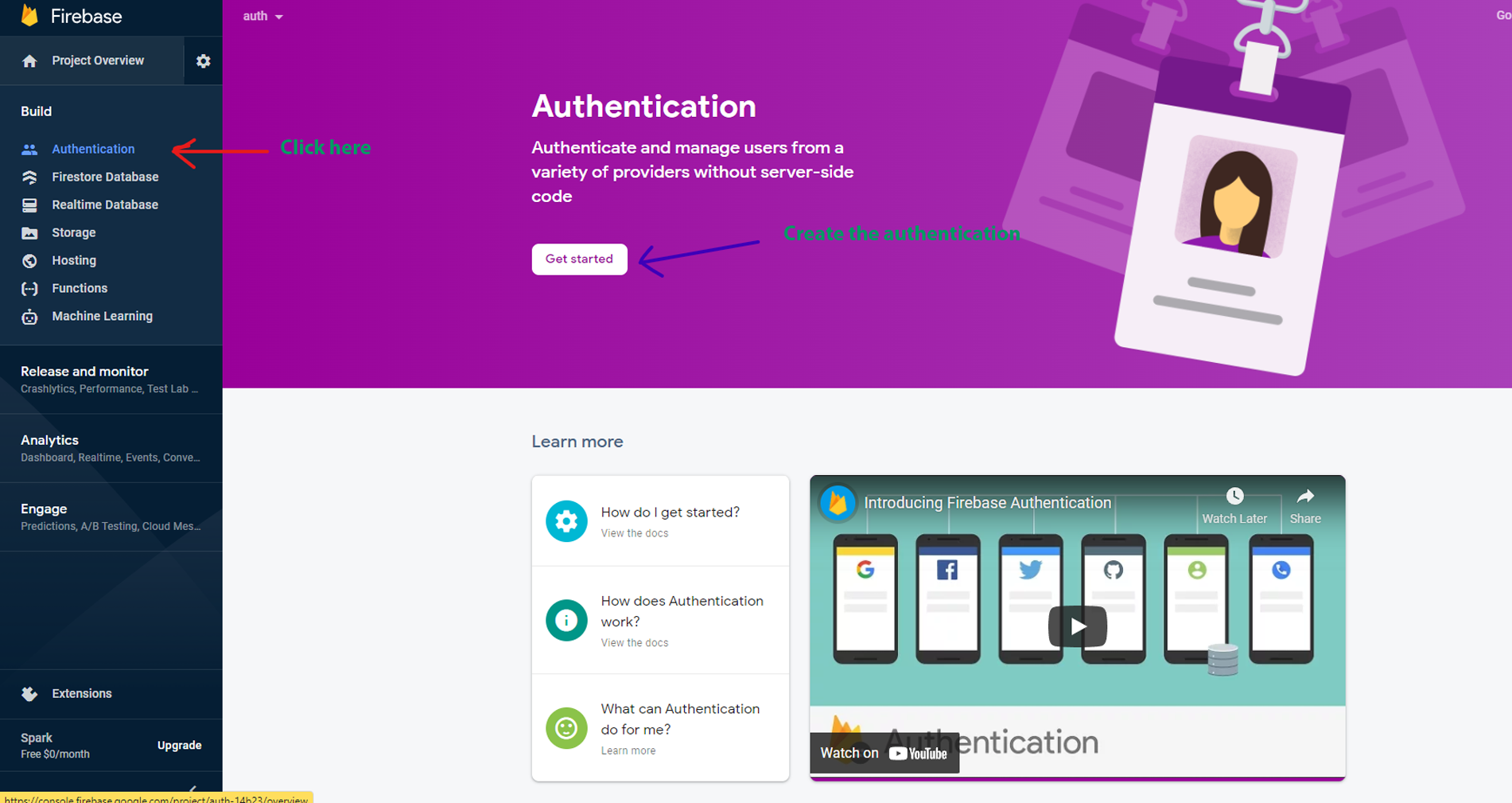
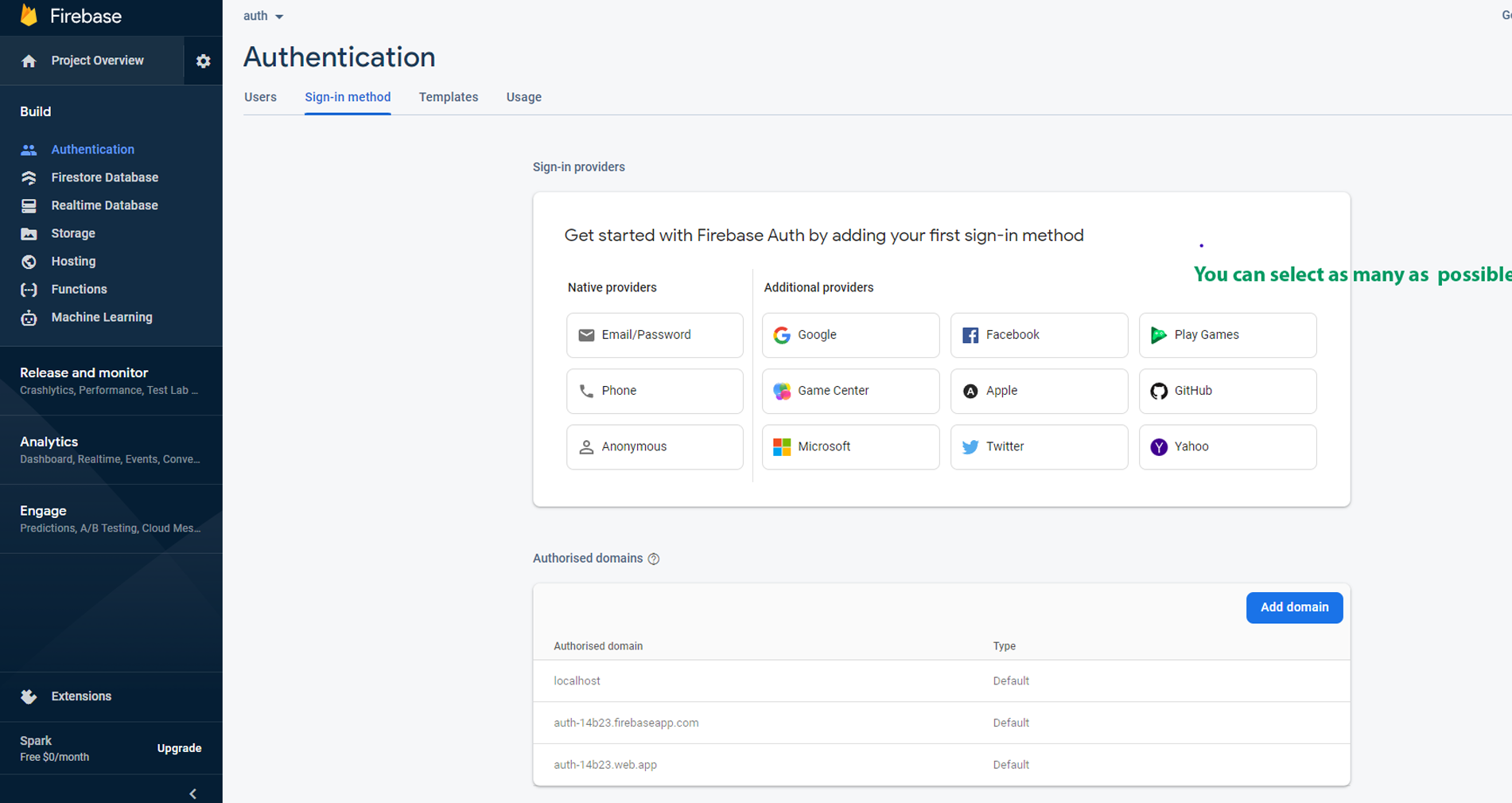
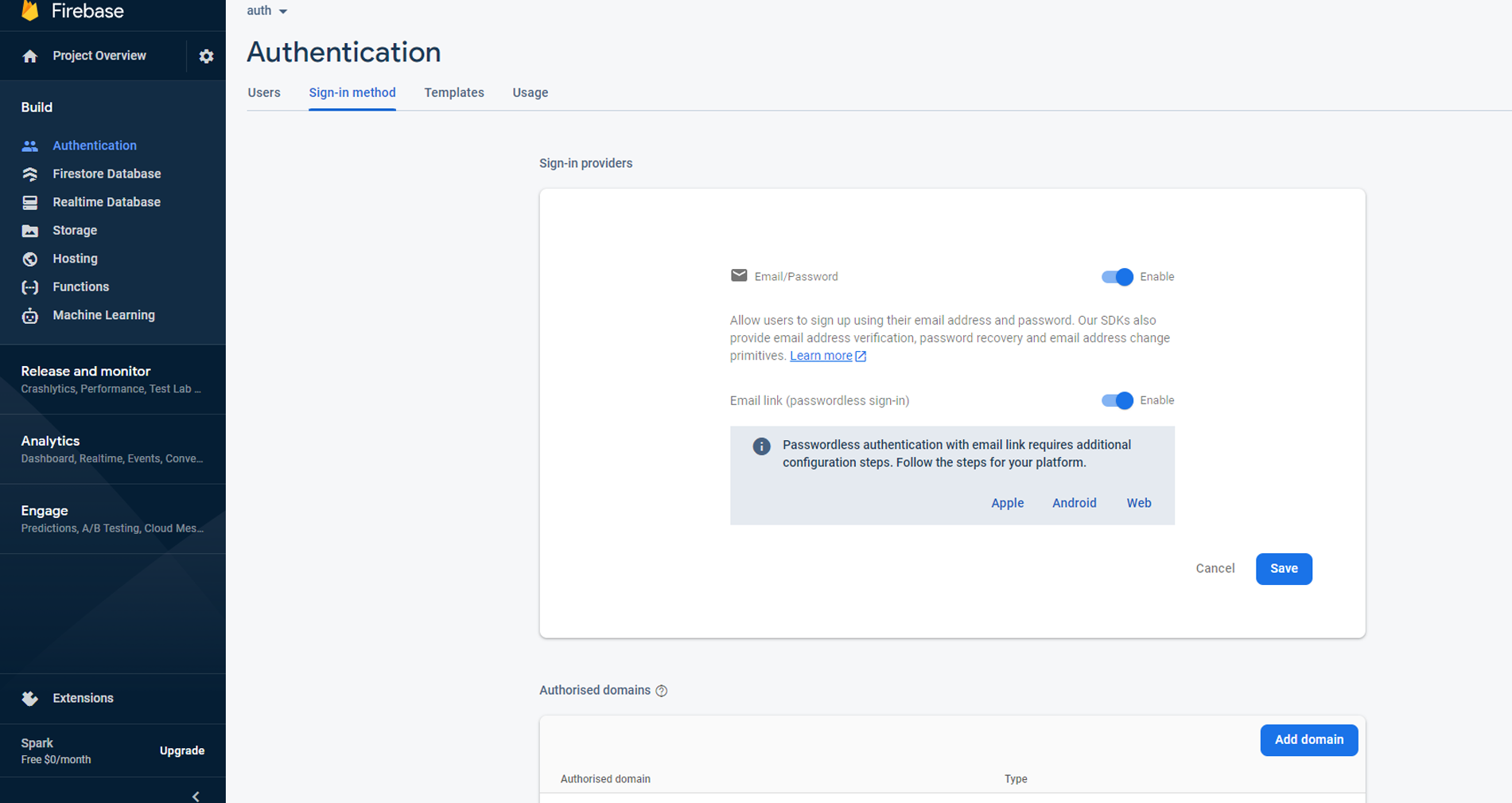
step-2: Add firebase API configuration details(create database on firebase) to the firebase Auth Component refer the path (resources\js\firebase\auth.jsx)
jsx
Firebase Revocation process
To remove firebase from the project make sure that you have to remove the firebase tab from the (resources\js\Pages\Login.jsx). change the key variable to 'React.js' Example : const [key, setKey] = useState('React.js') in the the (resources\js\Pages\Login.jsx).Firebase installation process
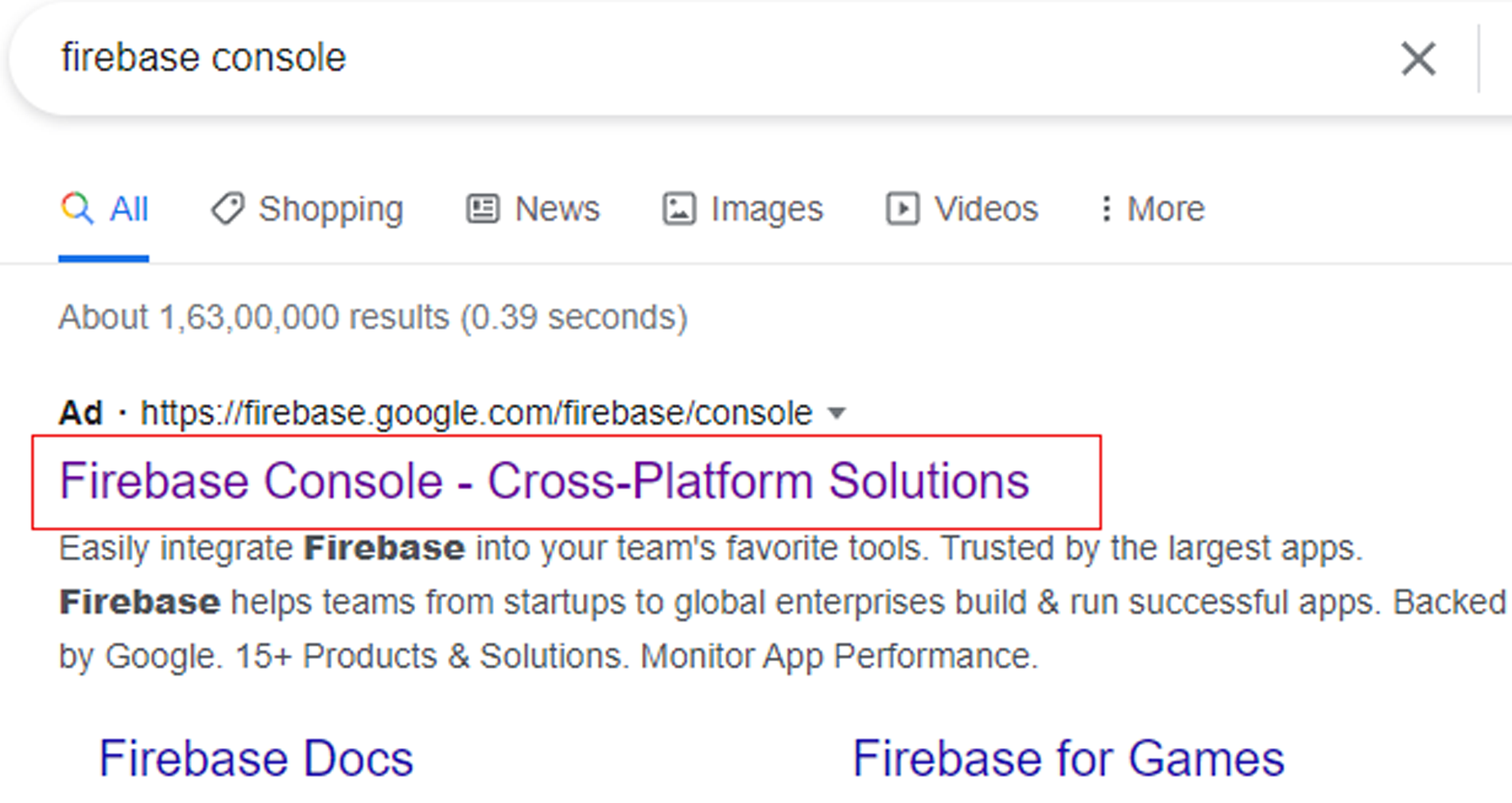
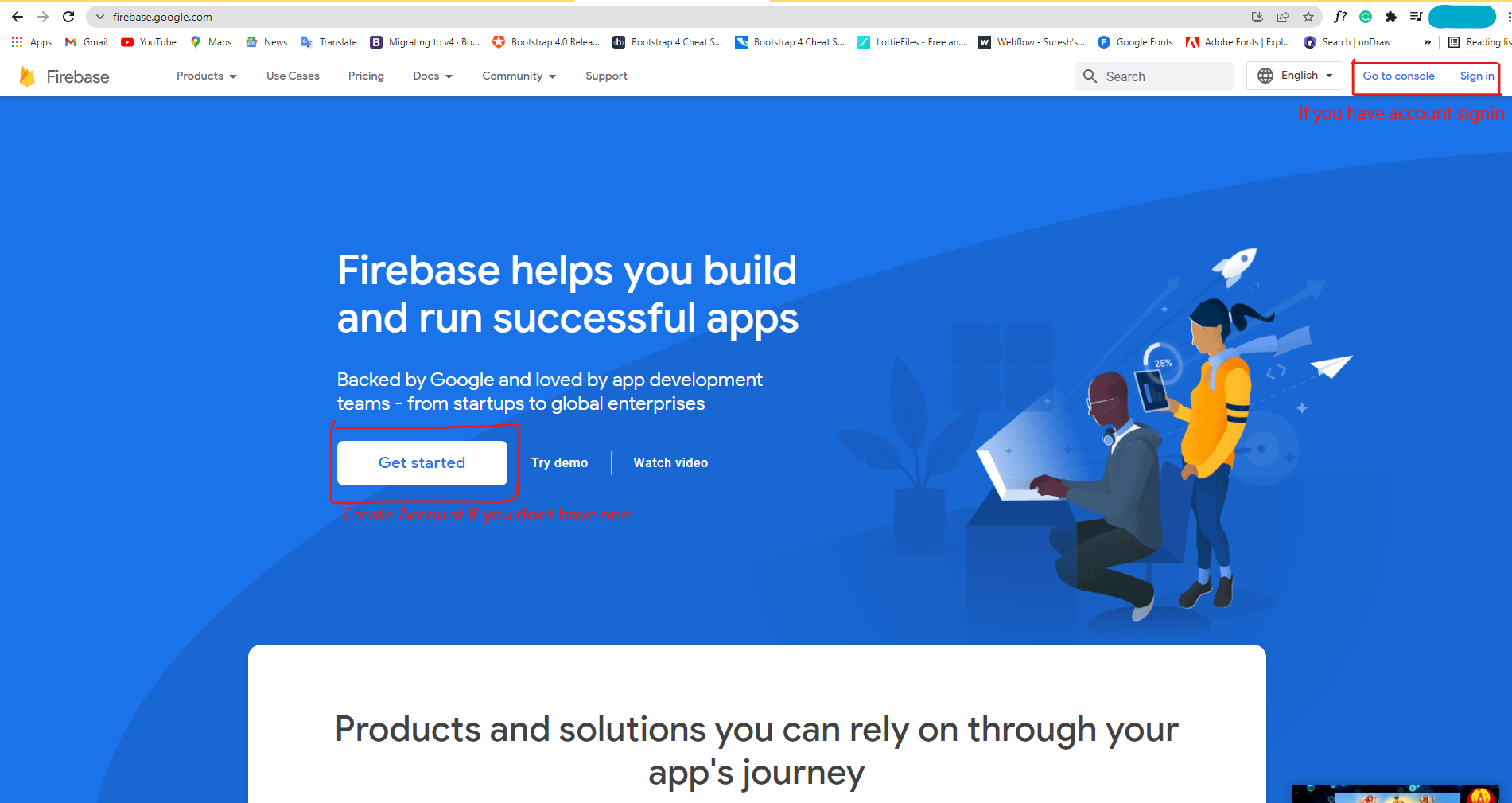
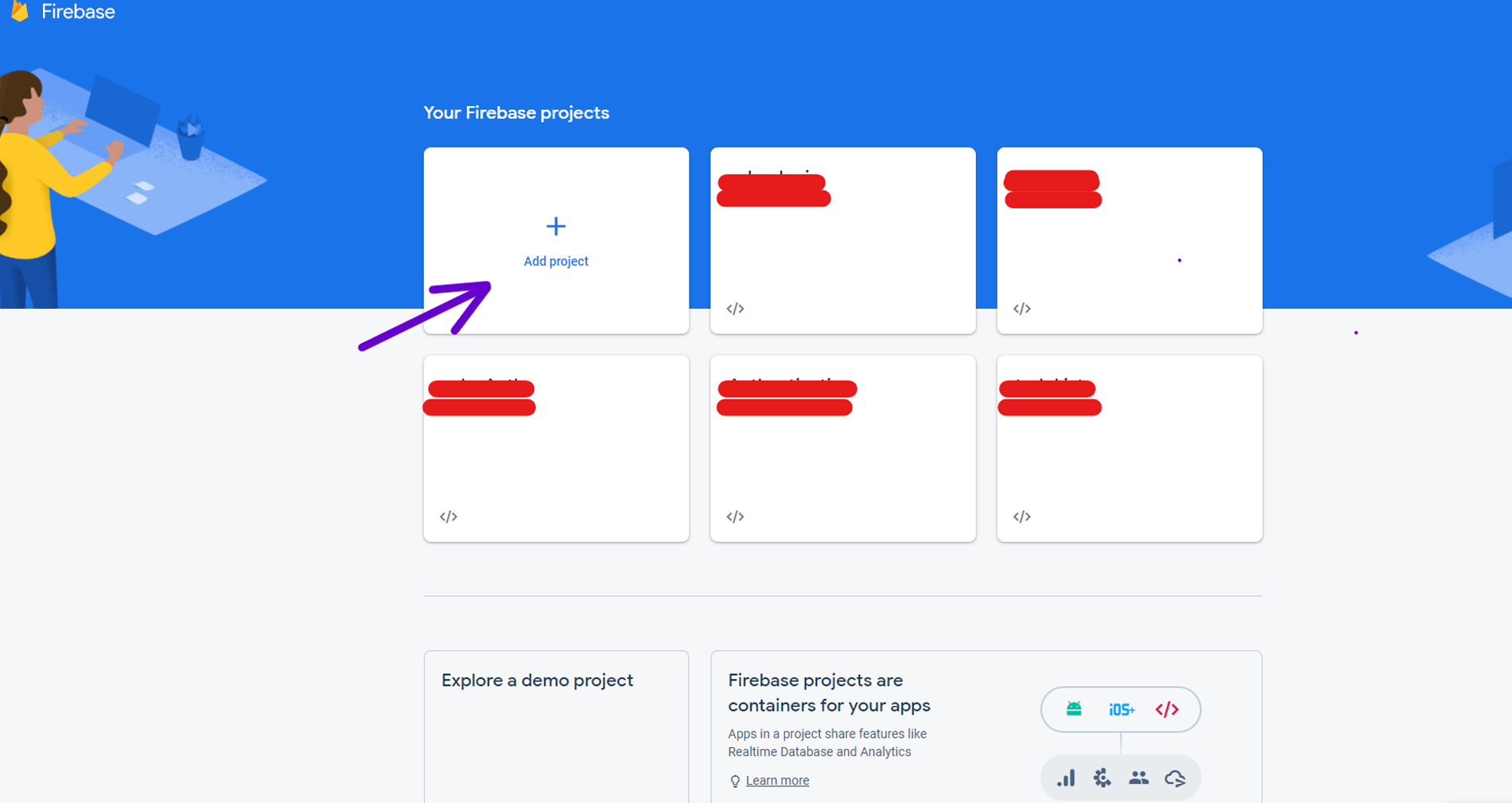
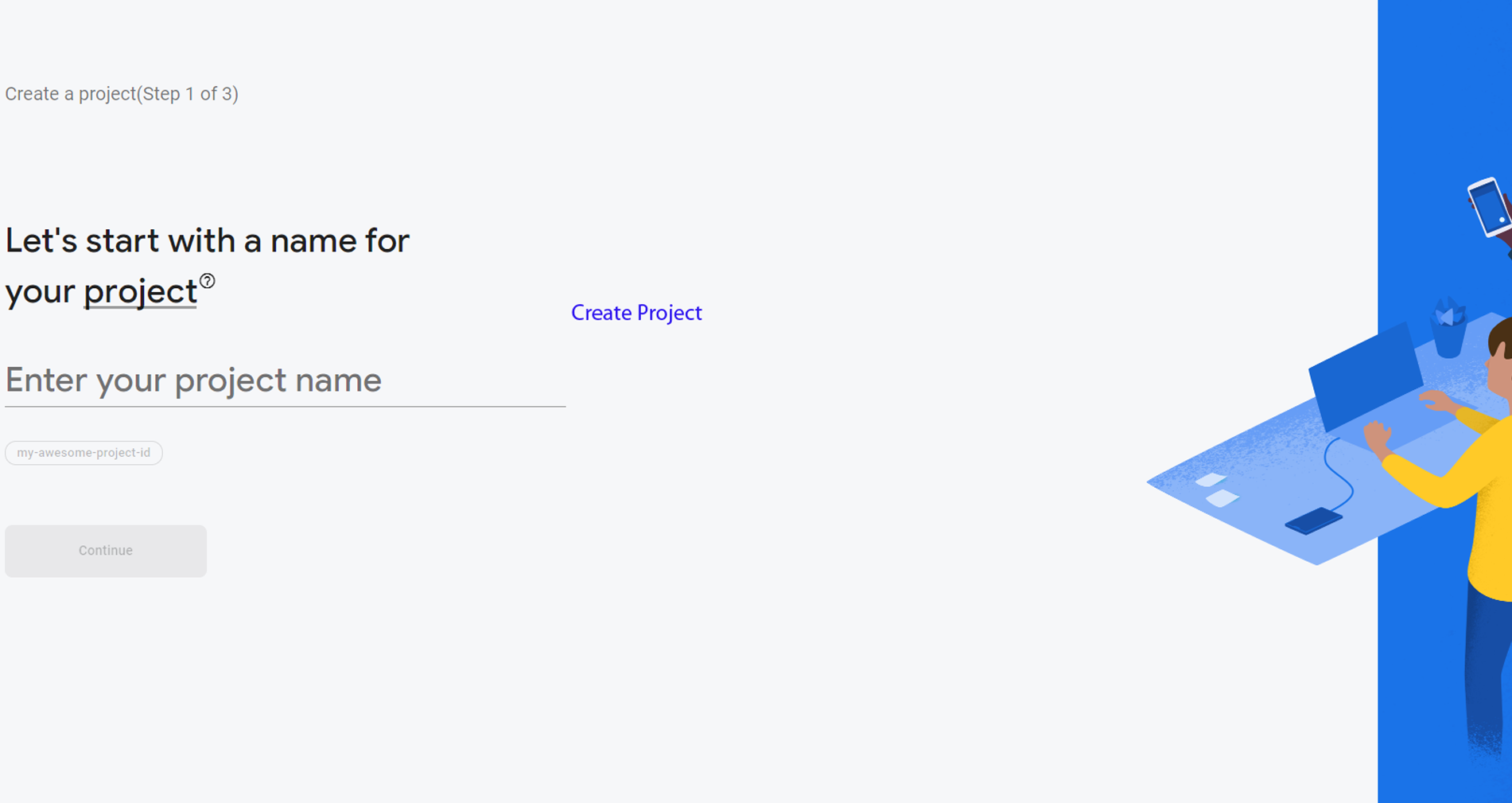
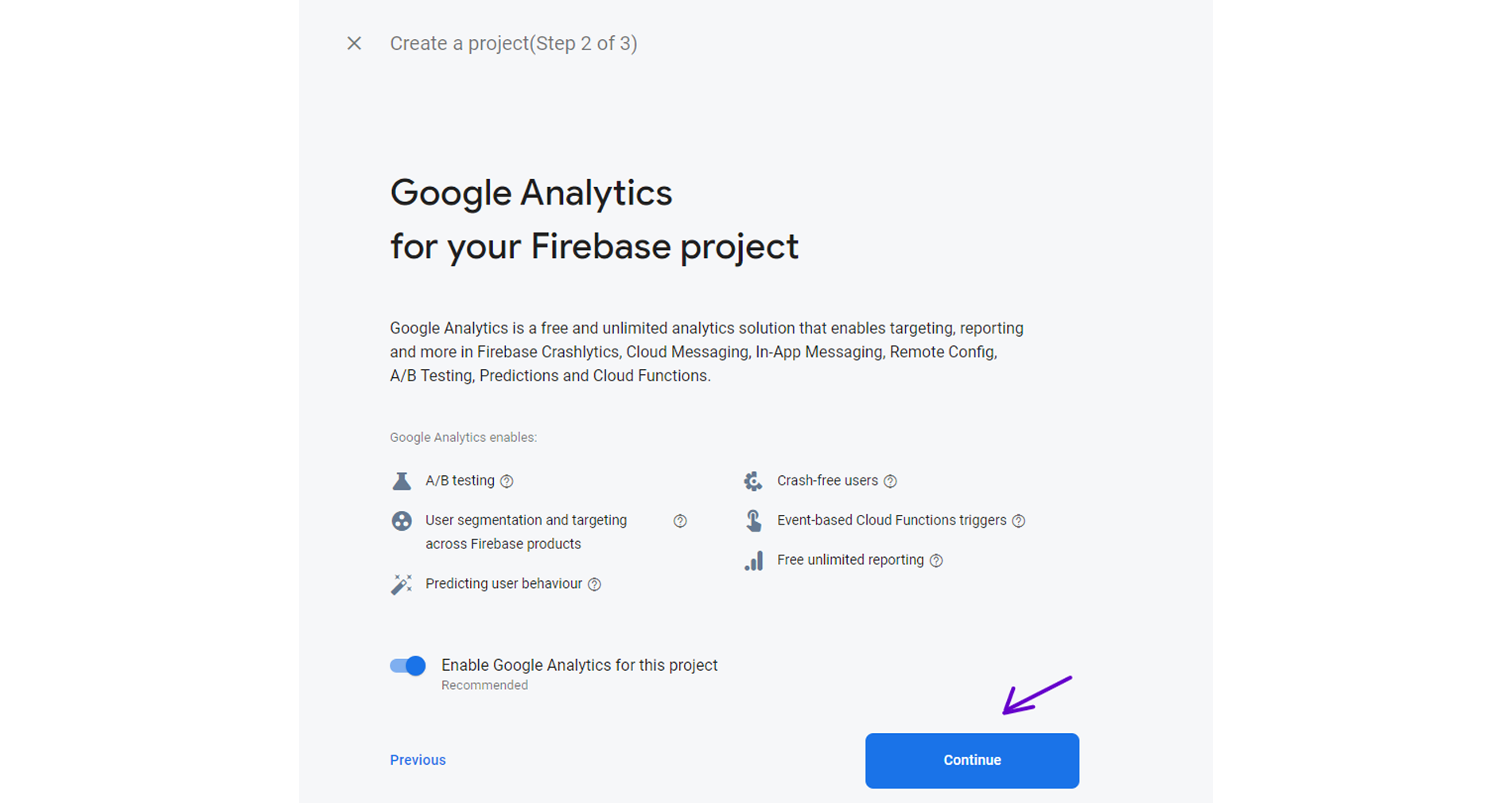
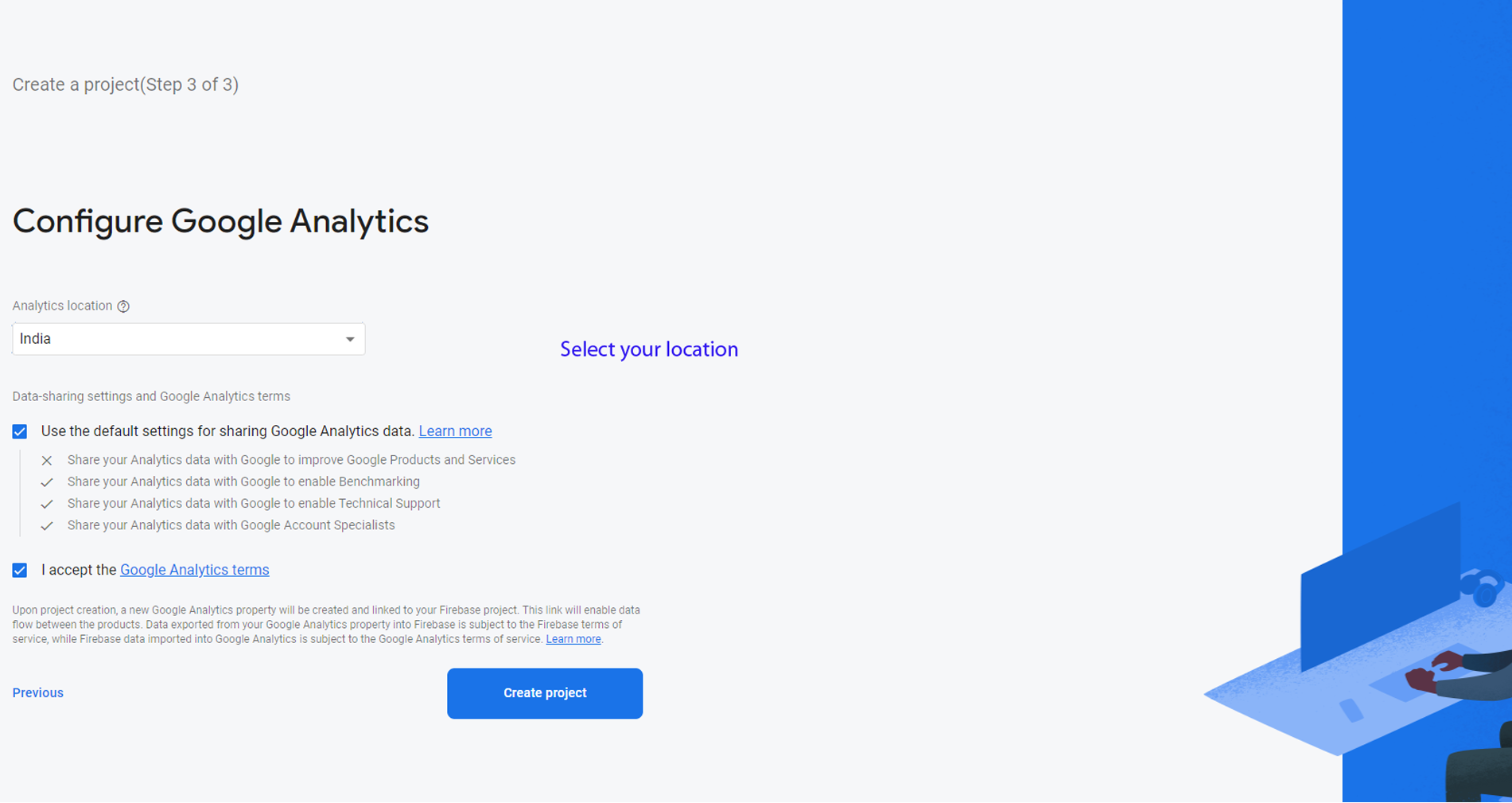
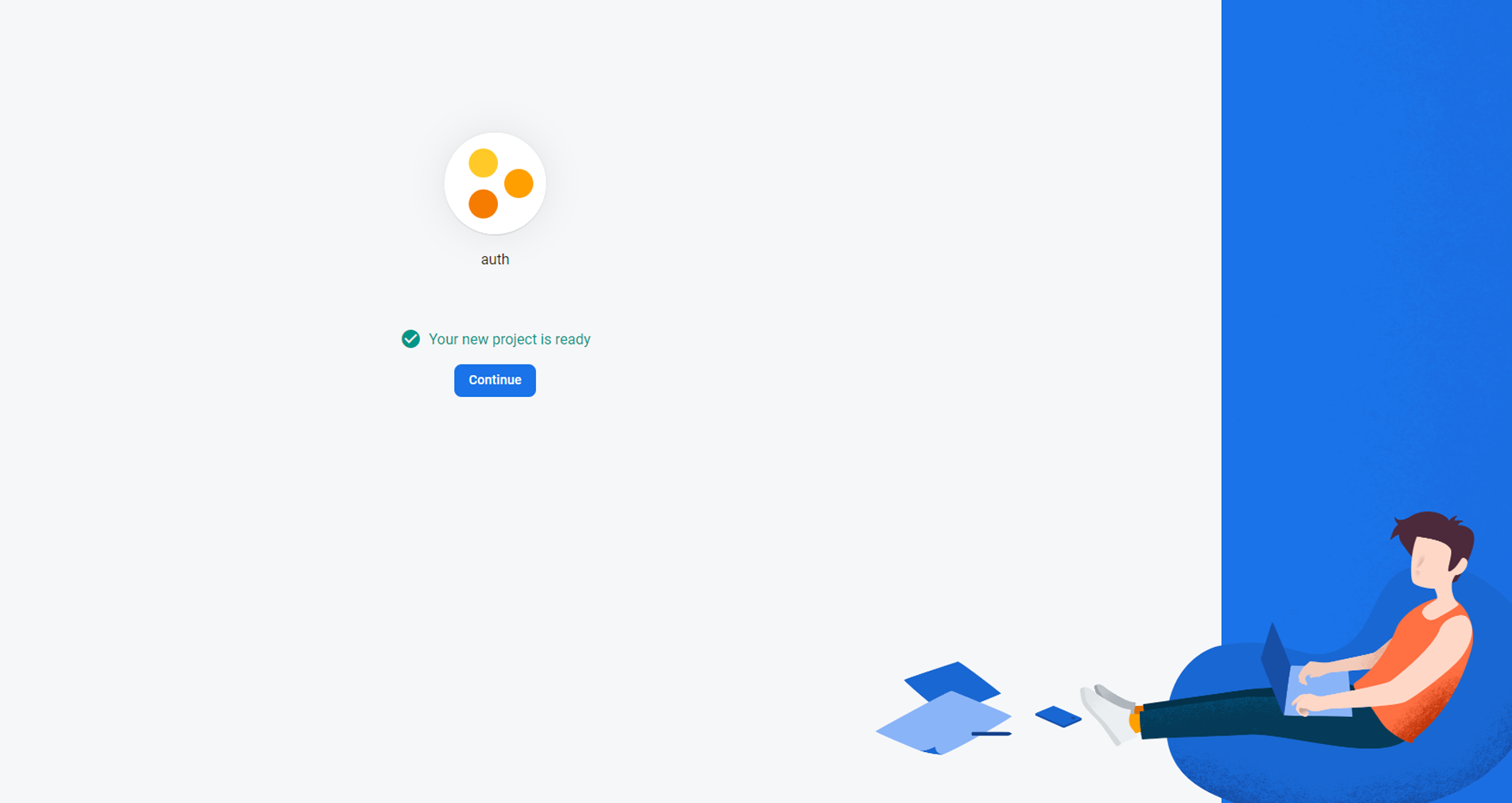
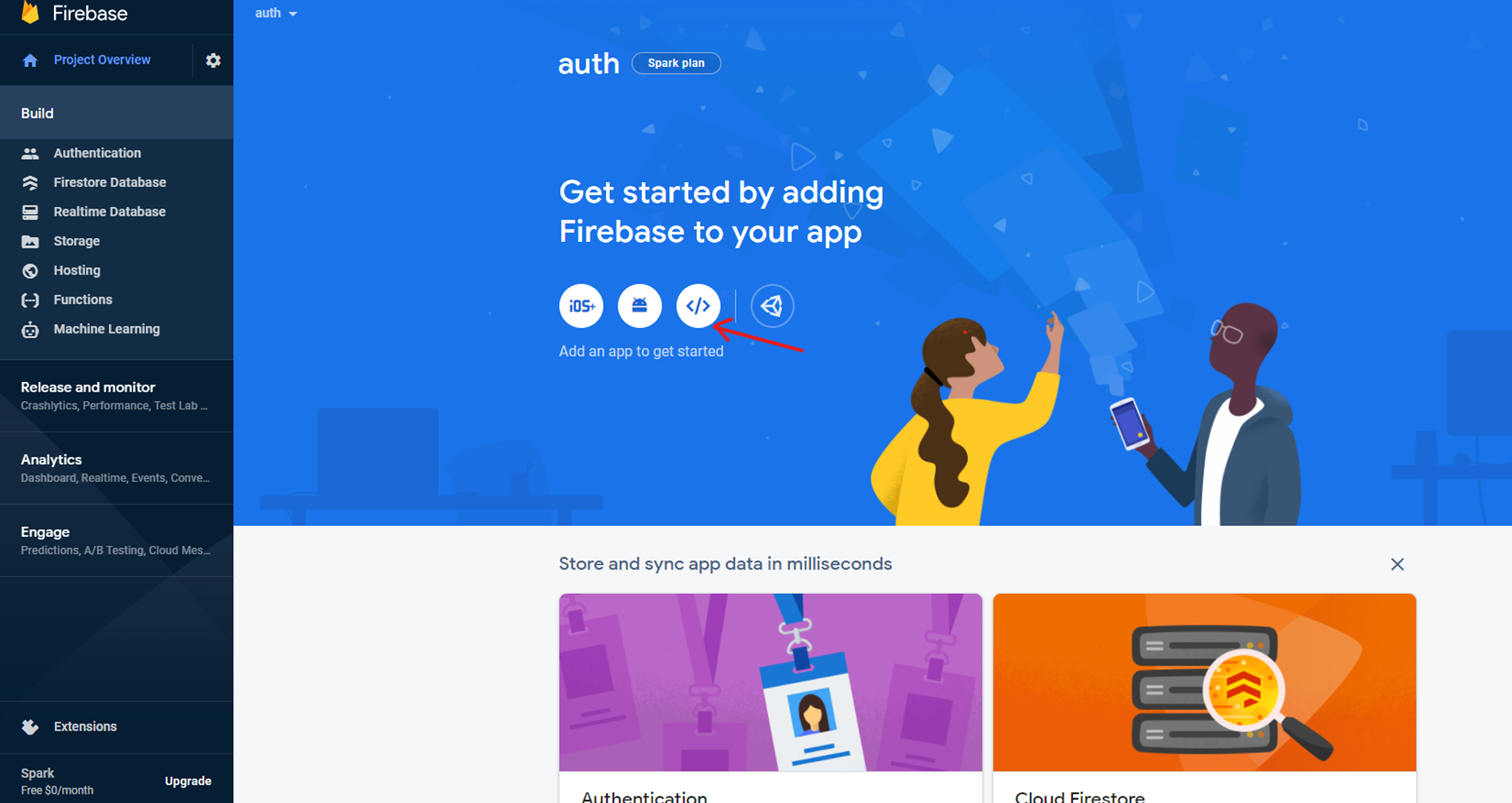
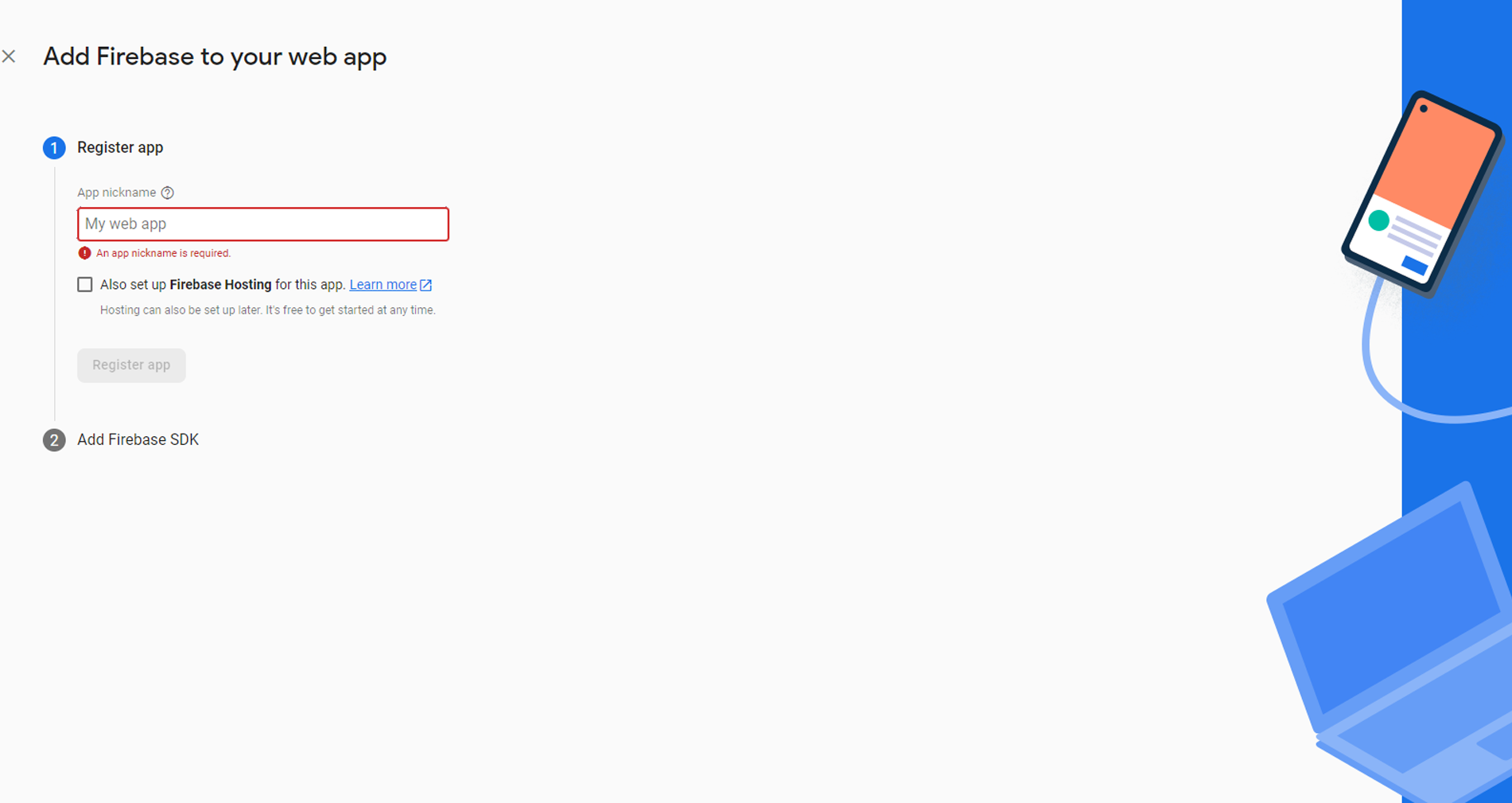
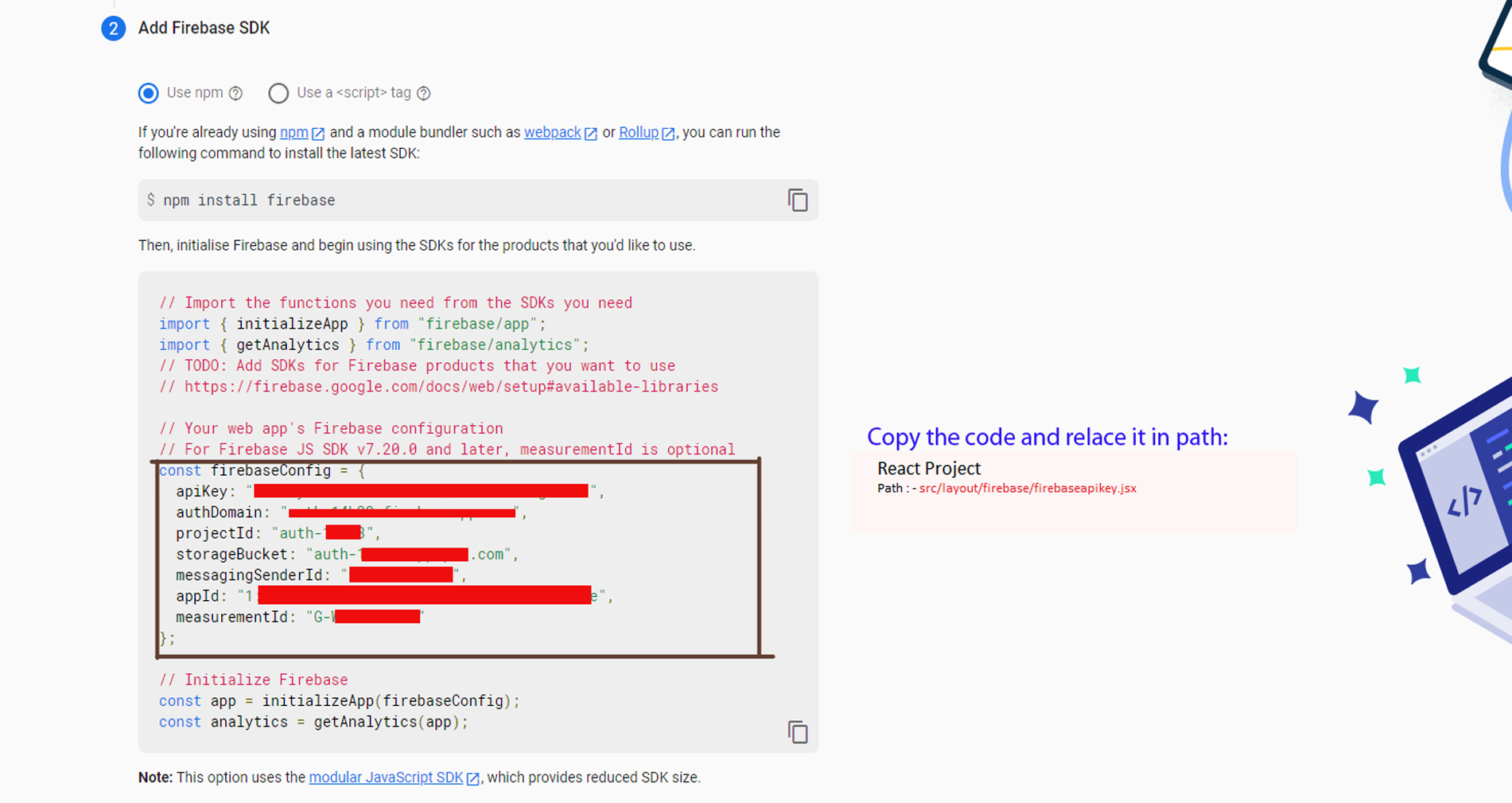
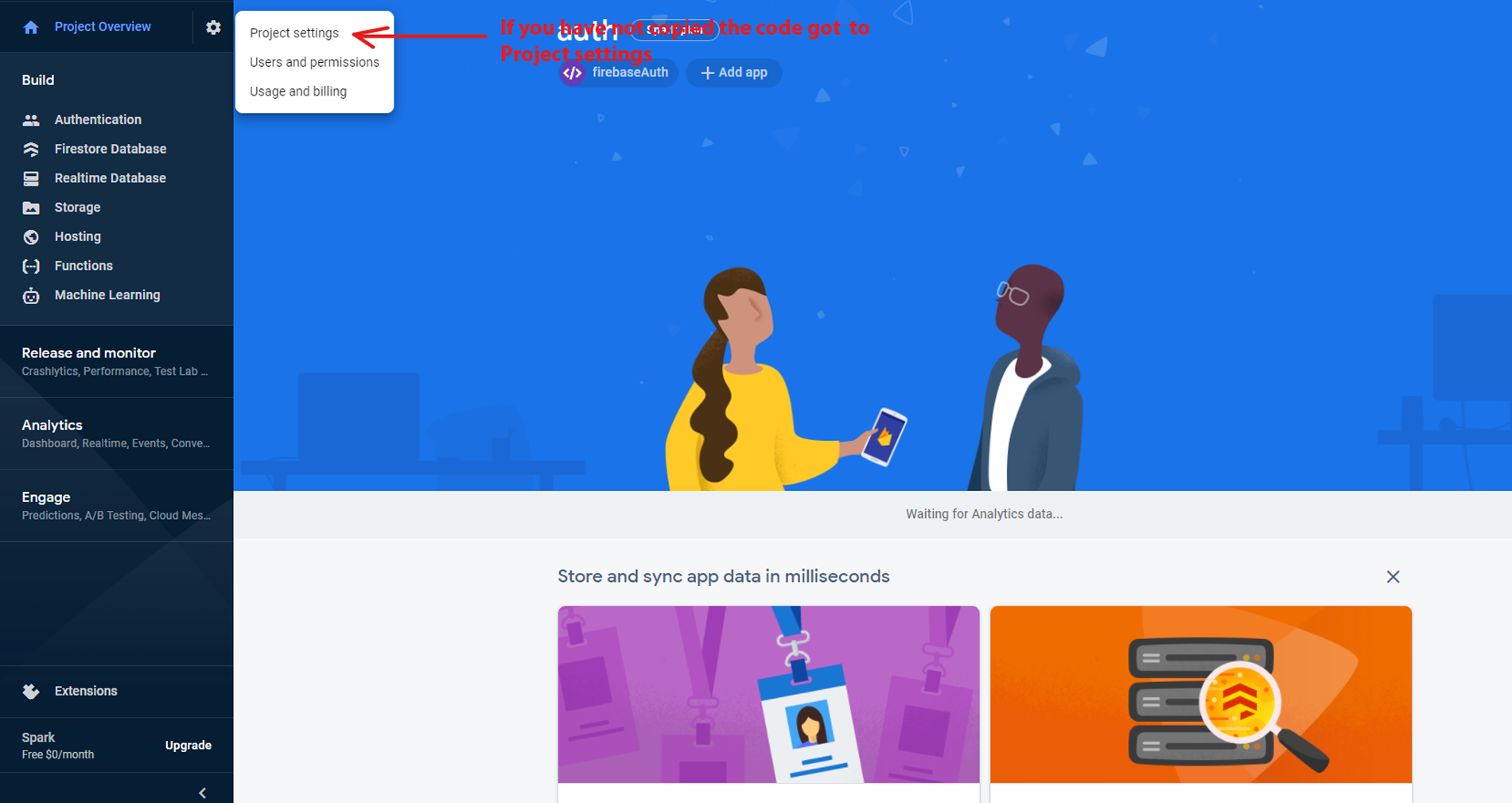
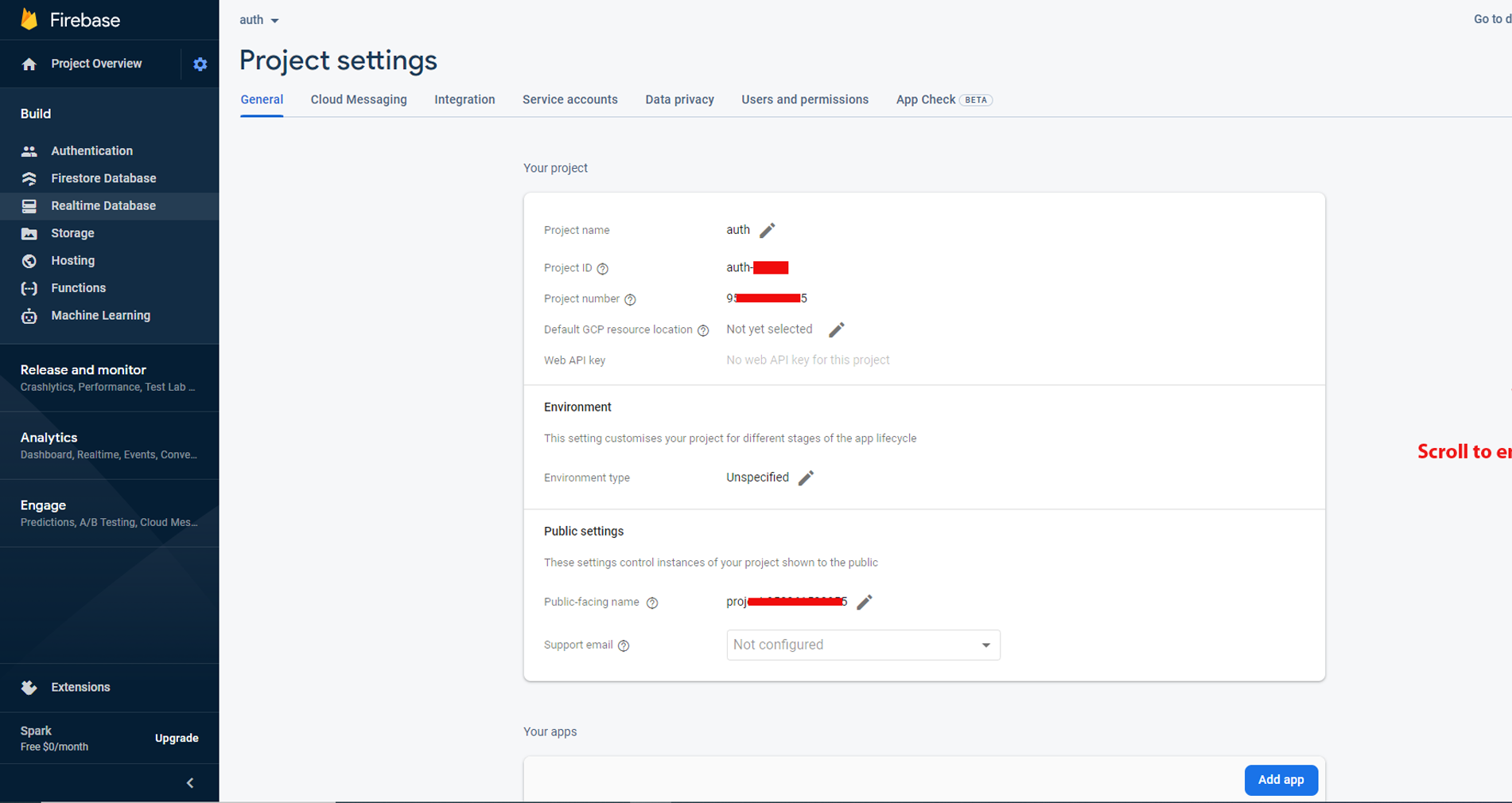
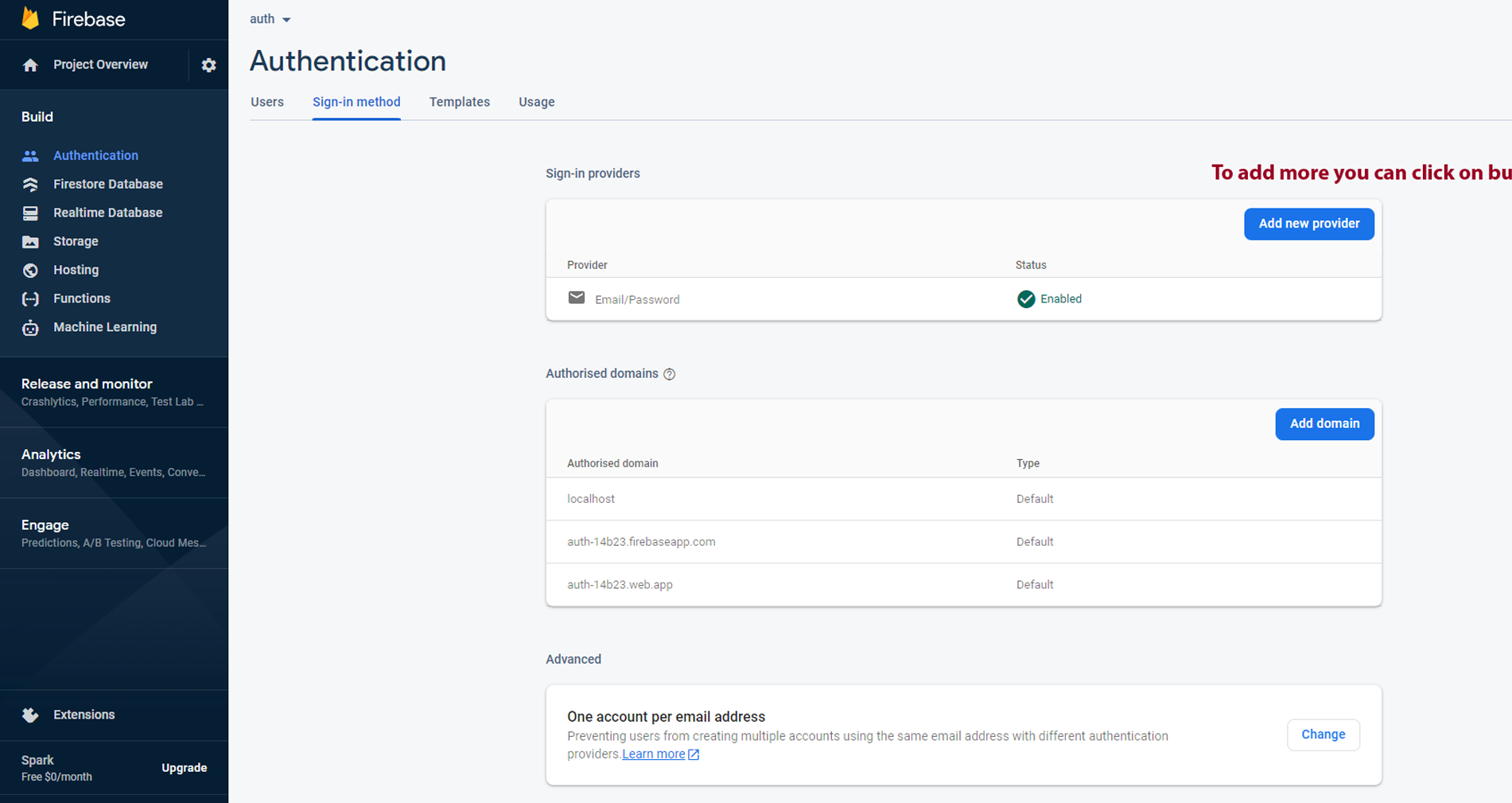
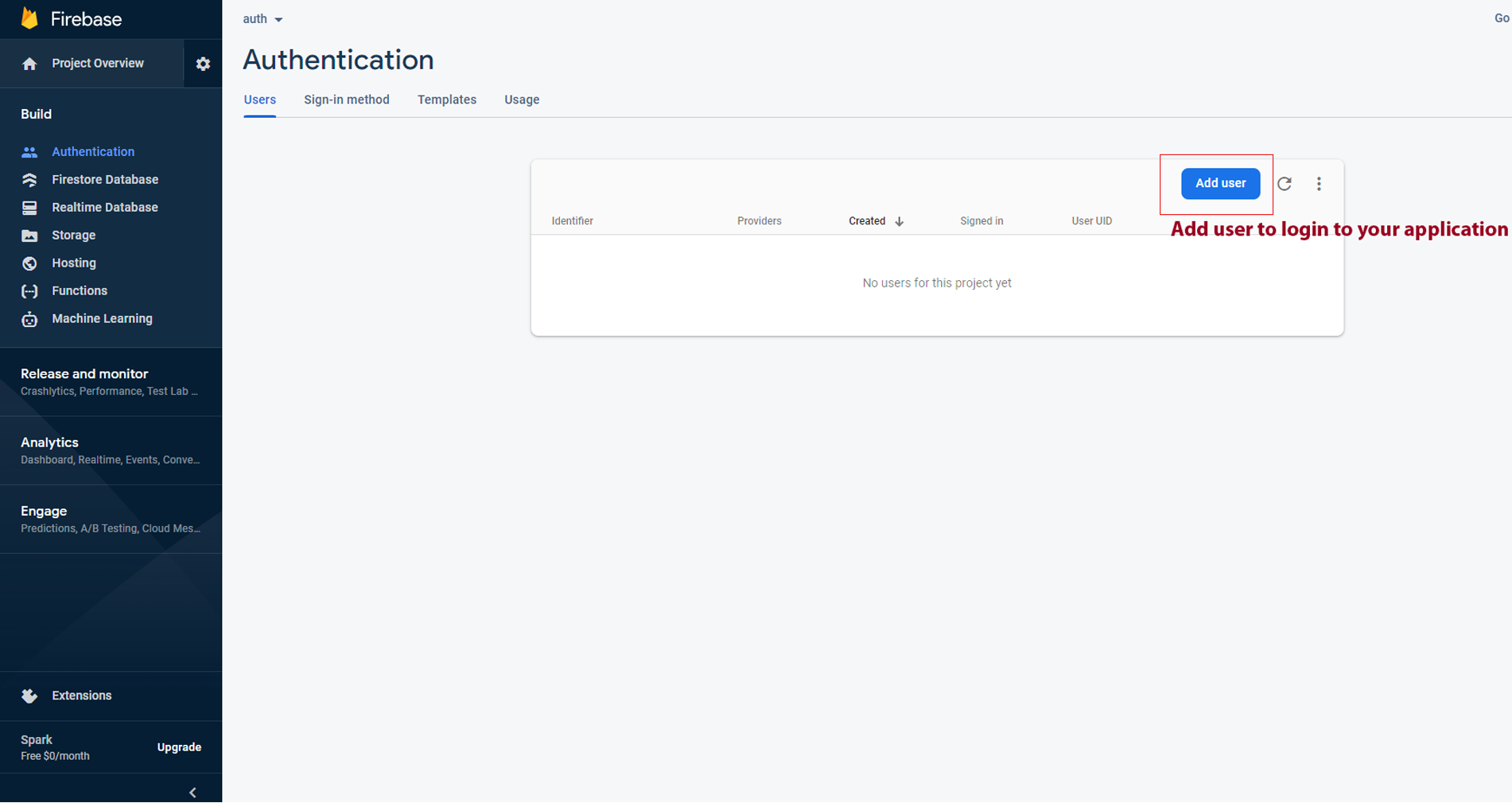
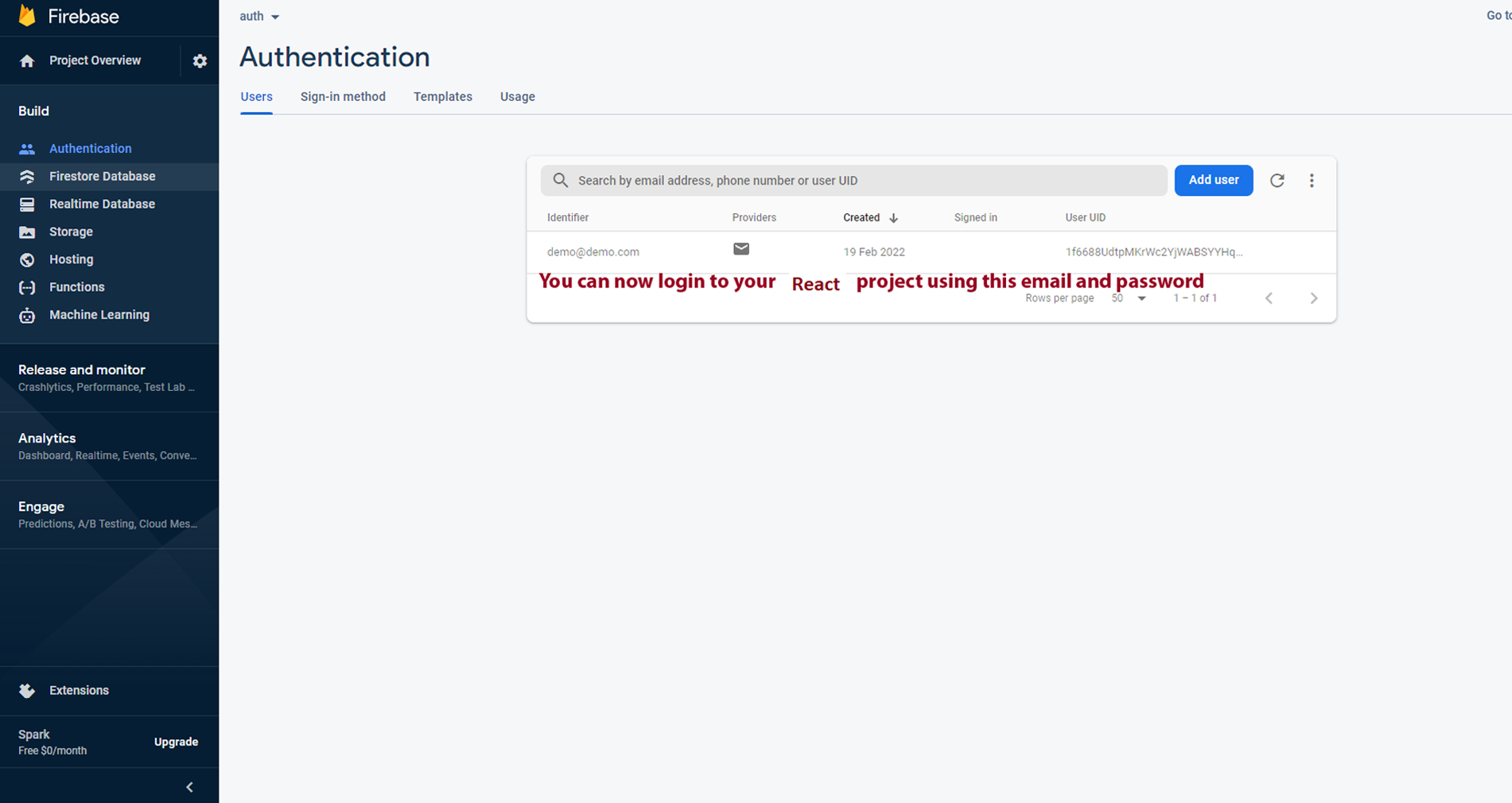
FAQ'S
Step 1:
Go To style.scss (resources/js/assets/scss/styles.scss )
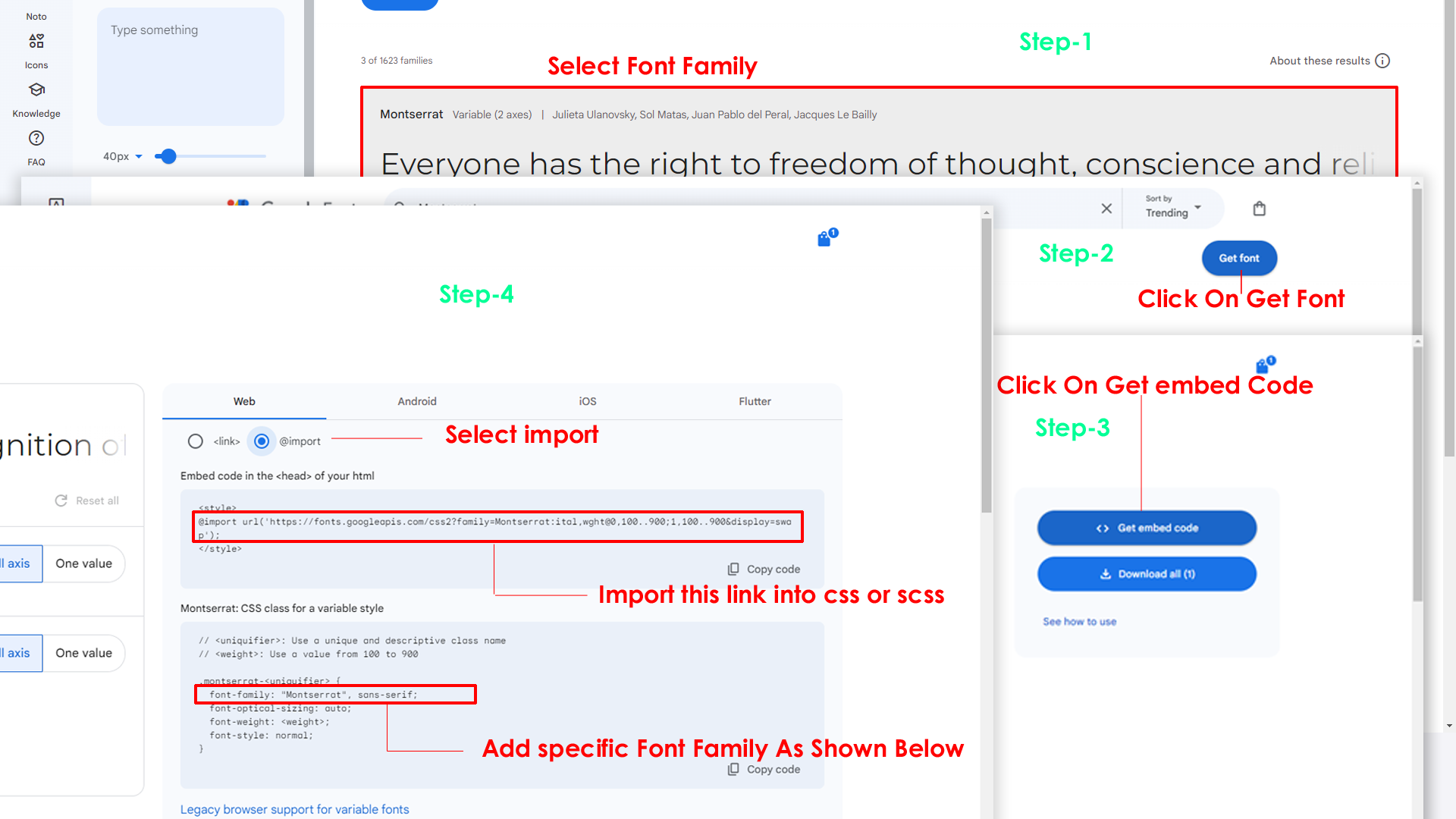
if you want to change another font-family Go to the site Google Fonts And Select One font Family and import in to styles.scss file
How to Select font Family
Step 2:
And paste Your Selected font-family in style.scss

Step 3:
And add the Your Selected font-family in _variables.scss(resources/js/assets/scss/_variables.scss)
code
--default-font-family: "Space Grotesk", sans-serif;By default menu icons are in the from remix icon if you want to change the icons please follow below steps
Step 1 :
To change Menu icons, open sidebar.jsx page
Path: resources\js\shared\layouts-components\sidebar\sidebar.jsx
and go through app-sidebar section, in that section
you will find
icon tag, there you can replace previous icon
with your icon. Example as shown in below
React
Go To
"resources/js/assets/images/brand-logos"
folder and replace
your
logo with Previous Logos within in image size.
note: Please don't increase logo sizes. Replace your logo
within
given
image size. otherwise the logo will not fit in particular
place
it
disturbs the template design.
Step1:
To clear LocalStorage loading functions you need to
remove
LocalStorageBackup() function in
custom-switcher.min.js
shared\data\switcherdata\switcherdata.jsx
as
shown
below
javascript
export const LocalStorageBackup {}Step2:
To remove complete LocalStorage saving you need to
remove
all localstorage related calling functions like
LocalStorageBackup in
switcher.jsx
resources\js\shared\layouts-components\switcher\switcher.jsxfile.Below
are
the some examples to find out.
jsx
    import { Initialload } from '../../../contextapi'
    const theme: any = useContext(Initialload);

    useEffect(() => {
        if (!theme.pageloading) {
          LocalStorageBackup(theme.setpageloading);
        }
}, []);Step1:
Open header.jsx component
resources\js\shared\layouts-components\header\header.jsx
To remove switcher section as shown below.
<li className="header-element">
<Link scroll={false} href="#!" className="header-link switcher-icon" data-bs-toggle="offcanvas" data-bs-target="#switcher-canvas" onClick={handleShow} >
    <svg xmlns="http://www.w3.org/2000/svg" className="header-link-icon" viewBox="0 0 256 256">
    <rect width="256" height="256" fill="none" />
    <path d="M207.86,123.18l16.78-21a99.14,99.14,0,0,0-10.07-24.29l-26.7-3a81,81,0,0,0-6.81-6.81l-3-26.71a99.43,99.43,0,0,0-24.3-10l-21,16.77a81.59,81.59,0,0,0-9.64,0l-21-16.78A99.14,99.14,0,0,0,77.91,41.43l-3,26.7a81,81,0,0,0-6.81,6.81l-26.71,3a99.43,99.43,0,0,0-10,24.3l16.77,21a81.59,81.59,0,0,0,0,9.64l-16.78,21a99.14,99.14,0,0,0,10.07,24.29l26.7,3a81,81,0,0,0,6.81,6.81l3,26.71a99.43,99.43,0,0,0,24.3,10l21-16.77a81.59,81.59,0,0,0,9.64,0l21,16.78a99.14,99.14,0,0,0,24.29-10.07l3-26.7a81,81,0,0,0,6.81-6.81l26.71-3a99.43,99.43,0,0,0,10-24.3l-16.77-21A81.59,81.59,0,0,0,207.86,123.18ZM128,168a40,40,0,1,1,40-40A40,40,0,0,1,128,168Z" opacity="0.2" />
    <circle cx="128" cy="128" r="40" fill="none" stroke="currentColor" strokeLinecap="round" strokeLinejoin="round" strokeWidth="16" />
    <path d="M41.43,178.09A99.14,99.14,0,0,1,31.36,153.8l16.78-21a81.59,81.59,0,0,1,0-9.64l-16.77-21a99.43,99.43,0,0,1,10.05-24.3l26.71-3a81,81,0,0,1,6.81-6.81l3-26.7A99.14,99.14,0,0,1,102.2,31.36l21,16.78a81.59,81.59,0,0,1,9.64,0l21-16.77a99.43,99.43,0,0,1,24.3,10.05l3,26.71a81,81,0,0,1,6.81,6.81l26.7,3a99.14,99.14,0,0,1,10.07,24.29l-16.78,21a81.59,81.59,0,0,1,0,9.64l16.77,21a99.43,99.43,0,0,1-10,24.3l-26.71,3a81,81,0,0,1-6.81,6.81l-3,26.7a99.14,99.14,0,0,1-24.29,10.07l-21-16.78a81.59,81.59,0,0,1-9.64,0l-21,16.77a99.43,99.43,0,0,1-24.3-10l-3-26.71a81,81,0,0,1-6.81-6.81Z" fill="none" stroke="currentColor" strokeLinecap="round" strokeLinejoin="round" strokeWidth="16" />
</svg>
    </Link>
    <Switcher show={show} handleClose={handleClose} />
</li>
Step2:
Remove the switcher component from the
main layout follow the path
Path: resources\js\shared\layouts-components\header\header.jsx
    import Switcher from '../switcher/switcher';

    <Switcher show={show} handleClose={handleClose} />
Step3:
Now remove the switcher component and switcherData file
from the root folder, follow the path
Switcher component resources/js/shared/layouts-components/switcher/switcher.jsx
and
switcherdata file from resources/js/shared/data/switcherdata/switcherdata.jsx
Step1:
Open authenticationlayout.jsx component
resources\js\Layouts\authenticationlayout.jsx
To remove switcher section as shown below.
import LandingSwitcher from '../shared/layouts-components/switcher/landing-switcher';

    <LandingSwitcher/>
Step2:
Remove the LandingSwitcher component from
the
main layout follow the path
\src\pages\landinglayout.jsx
            import Landingswitcher from '../shared/layouts-components/switcher/landing-switcher'

            <Landingswitcher />
Step3:
Now remove the landingswitcher component from the root
folder, follow the path
resources\js\shared\layouts-components\switcher\landing-switcher.jsx
and
Please follow the below steps to change Primary Color
Step 1 :
To change Primary Color you have to open _variables.scss file and replace what color you want as shown in below
Rootpath : _variables.scss (resources/js/assets/scss/_variables.scss )

Please follow the below steps to change Dark body Color
Step 1 :
Make sure the theme is set completely to dark mode by adding the following attributes to the html tag data-theme-mode="dark" data-header-styles="dark" data-menu-styles="dark"
Step 2 :
To change Dark body Color you have to open _variables.scss file and replace what color you want as shown in below
Rootpath : _variables.scss (resources/js/assets/scss/_variables.scss )
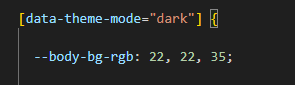
Step 3 :
Also Change the following variable colors to the desired theme background accordingly in [data-theme-mode="dark"]
--light-rgb : --form-control-bg : --input-border : --gray-3 :Credit's
Icons Credit
| Icons | References |
|---|---|
| Bootstrap Icons | https://icons.getbootstrap.com/ |
| Boxicons | https://boxicons.com/ |
| Remix Icons | https://remixicon.com/ |
| Feather Icons | https://feathericons.com/ |
| Tabler Icons | https://tabler-icons.io/ |
| Line Awesome Icons | https://icons8.com/line-awesome |
| Phosphor Icons | https://phosphoricons.com/ |
Images Credit
| Images | References |
|---|---|
| Vecteezy | https://www.vecteezy.com/ |
| Iconscount | https://iconscout.com/ |
| Unsplash | https://unsplash.com/ |
| Png Tree | https://pngtree.com/ |
| flaticon | https://www.flaticon.com/authors/flat-icons |
| freepik | https://www.freepik.com |
Fonts Credit
| Font | References |
|---|---|
| Google Fonts | https://fonts.google.com/ |
Sidemenu Icons
| Icon | References |
|---|---|
| phosphor Icons | https://phosphoricons.com/ |
Switcher styles
(resources/views/app.blade.php)
html
<html lang="en" dir="ltr" data-nav-layout="vertical" data-theme-mode="light" data-header-styles="transparent" data-width="fullwidth" data-menu-styles="transparent" data-page-style="flat" data-toggled="close" data-vertical-style="doublemenu" data-toggled="double-menu-open">html
data-theme-mode="light" data-header-styles="light" data-menu-styles="light"html
data-theme-mode="dark" data-header-styles="dark" data-menu-styles="dark"html
dir="ltr"html
dir="rtl"html
data-nav-layout="vertical"html
data-nav-layout="horizontal" data-nav-style="menu-click"html
data-page-style="regular"html
data-page-style="classic"html
data-page-style="modern"html
data-page-style="flat"html
data-width="default"html
data-width="full-width"html
data-width="boxed"html
data-header-position="fixed"html
data-header-position="scrollable"html
data-vertical-style="closed"html
data-vertical-style="icontext"html
data-vertical-style="overlay"html
data-vertical-style="detached"html
data-vertical-style="doublemenu"html
loader="enable"html
loader="disable"html
data-menu-styles="light"html
data-menu-styles="dark"html
data-menu-styles="color"html
data-menu-styles="gradient"html
data-menu-styles="transparent"html
data-header-styles="light"html
data-header-styles="dark"html
data-header-styles="color"html
data-header-styles="gradient"html
data-header-styles="transparent"html
data-bg-img="bgimg1"html
data-bg-img="bgimg2"html
data-bg-img="bgimg3"html
data-bg-img="bgimg4"html
data-bg-img="bgimg5"Swiper JS :
React Swiper is a modern, feature-packed carousel component for React, offering smooth transitions, touch support, and advanced features like autoplay and lazy loading. It’s a flexible, performance-driven alternative to traditional carousels like Bootstrap.
React
React
css
React
Plugin Link
https://swiperjs.com/reactReference Link
https://www.npmjs.com/package/swiperReact-Apexcharts :
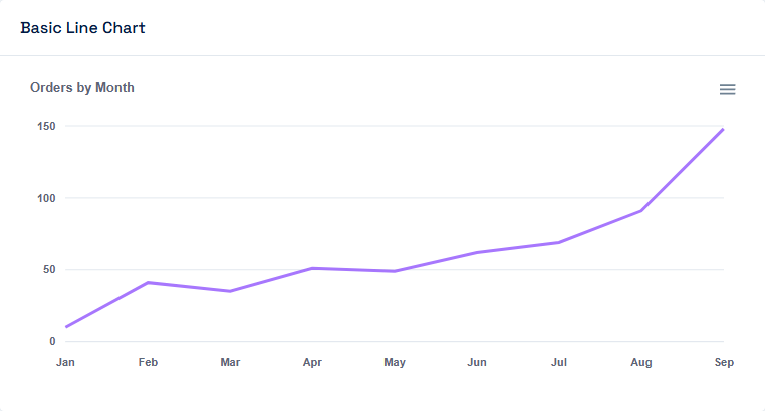
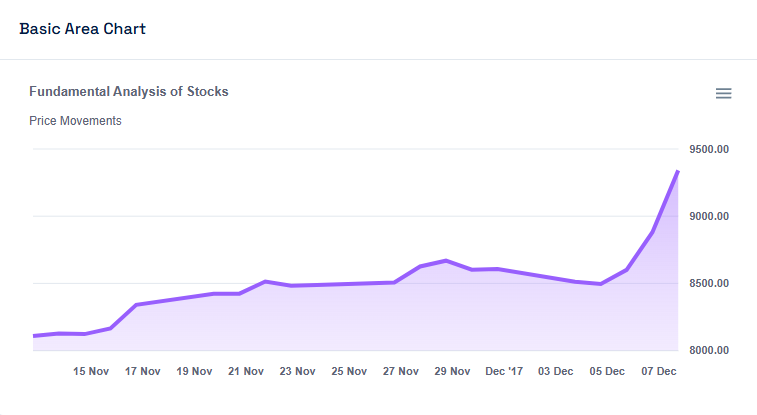
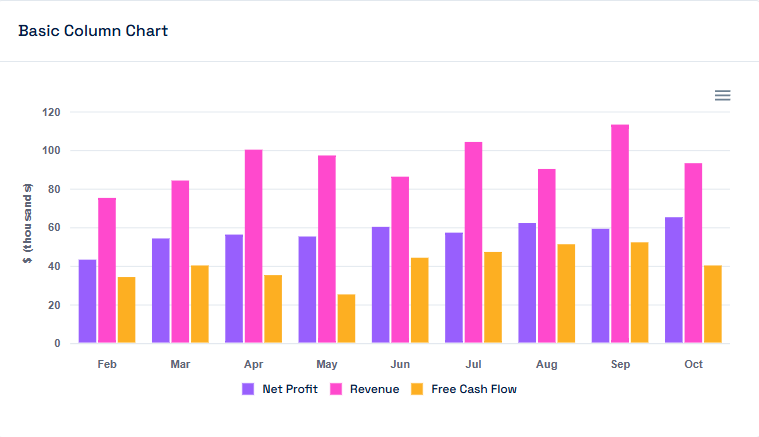
React-ApexCharts is a React wrapper for the popular ApexCharts library, enabling the easy creation of interactive, responsive charts. It offers a wide range of chart types and customization options with seamless React integration.
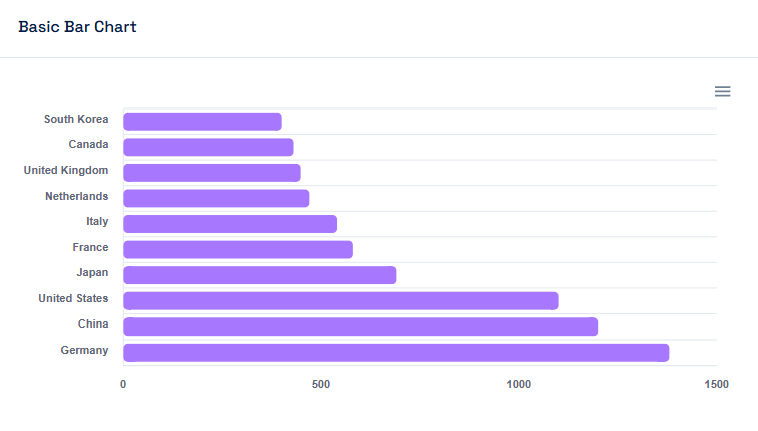
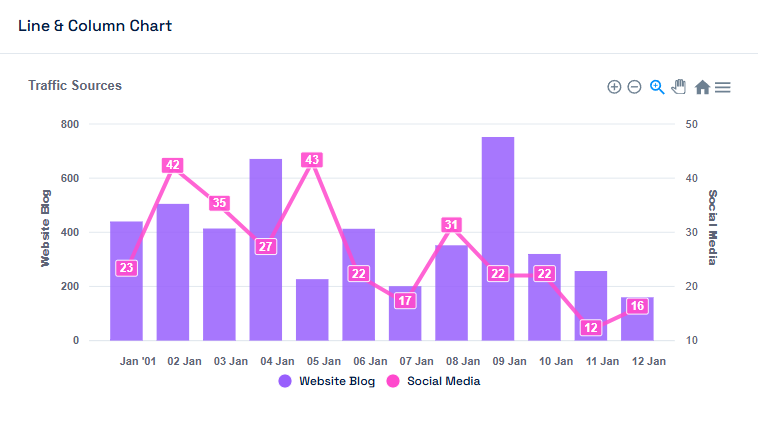
React
React
React
Plugin Link
https://www.npmjs.com/package/apexchartsReference Link
https://apexcharts.com/react-chart-demos/React Suneditor :
React SunEditor is a lightweight, customizable editor for React, providing rich text editingfeatures. It supports various formats, plugins, and is highly extensible for smooth integration into React applications.
React
React
css
React
Plugin Link
https://www.npmjs.com/package/suneditor-reactReference Link
https://www.npmjs.com/package/suneditor-reactReact DatePicker :
React Datepicker is a React wrapper for the Datepicker date picker library, offering a lightweight and customizable solution for selecting dates and times. It provides smooth integration, supports various date formats, and includes features like range selection, time picking, and more.
React
React
css
Plugin Link
https://www.npmjs.com/package/react-datepickerReference Link
https://reactdatepicker.com/React Select :
React Select is a flexible, customizable dropdown/select input component for React, offering features like multi-select, search, and async options. It provides an intuitive, user-friendly interface with advanced styling and accessibility support.
React
React
React
Plugin Link
https://www.npmjs.com/package/react-selectReference Link
https://www.npmjs.com/package/suneditor-reactReact GridJs :
React Grid.js is a React wrapper for the Grid.js table library, enabling the creation of interactive, customizable, and responsive data tables. It supports features like sorting, filtering, pagination, and inline editing, with a focus on performance and easy integration into React projects.
React
React
React
css
Plugin Link
https://www.npmjs.com/package/gridjs-reactReference Link
https://gridjs.io/docs/examples/hello-worldReact Toastify :
React Toastify is a lightweight and easy-to-use notification library for React that allows you to display customizable, non-blocking toast messages. It supports various notification types, automatic dismissal, and seamless integration, enhancing the user experience with minimal setup.
React
React
Plugin Link
https://www.npmjs.com/package/react-toastifyReference Link
https://fkhadra.github.io/react-toastify/introduction/React Ratings(MUI) :
React Material-UI Ratings is a component that integrates Material-UI's design system to create customizable, interactive rating systems in React applications. It allows users to easily select a rating through stars or other symbols, with built-in support for customization, accessibility, and styling.
React
React
Plugin Link
https://www.npmjs.com/package/@mui/materialReference Link
https://mui.com/material-ui/react-rating/Basic Table : :
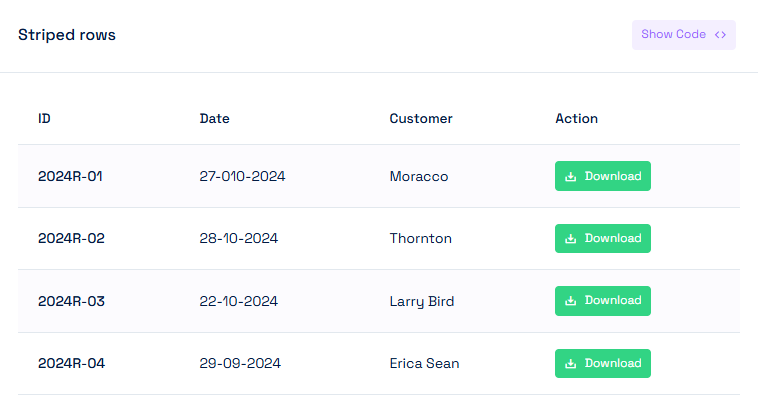
React Basic tables are simple, customizable table components for displaying structured data in a clean and responsive layout
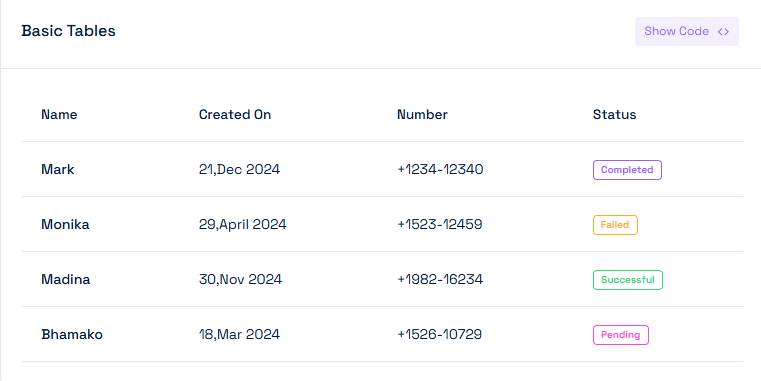
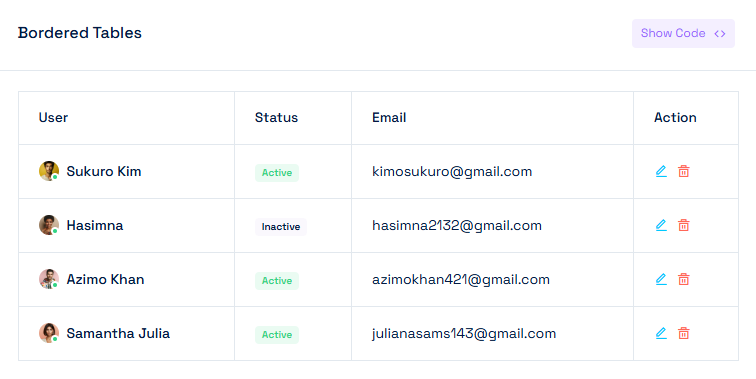
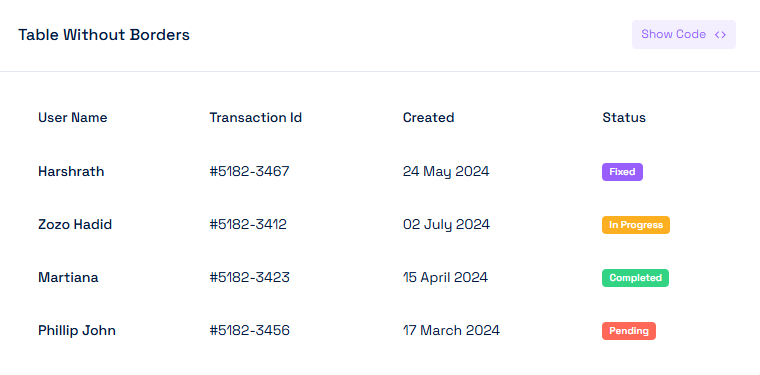
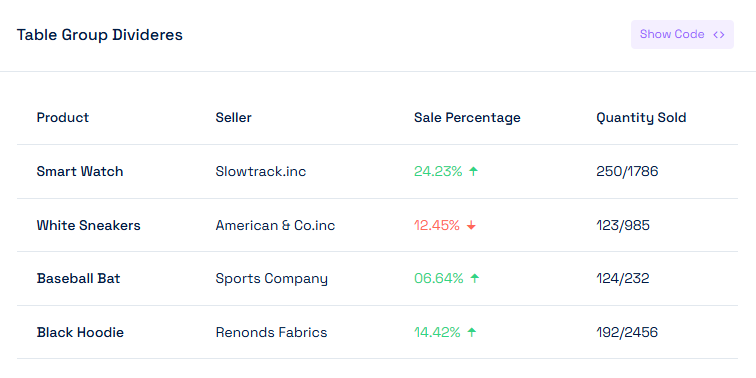
React
data
Alerts :
React Bootstrap Alerts are pre-styled, customizable alert components that integrate Bootstrap's alert system with React. They provide an easy way to display important messages or notifications, with built-in support for different styles (success, error, info, etc.), dismissible functionality, and seamless React integration.
React
data
Buttons :
React Bootstrap Buttons are pre-styled, responsive button components that follow React Bootstrap’s design system, offering various styles, sizes, and colors. They provide an easy-to-use and customizable solution for creating interactive buttons in React applications, with support for icons, loading states, and more.

React
data
Badges :
React Bootstrap Badges are small, customizable components used to display labels, notifications, or counters within your React application. They integrate seamlessly with React Bootstrap’s design system and support various styles, colors, and positions, making them ideal for highlighting important information or adding context to UI elements like buttons, links, or navigation items.

React
data
Button Group :
React Bootstrap Button Group is a component that allows you to group multiple buttons together, providing a clean, unified look and facilitating interactions like toggling or switching between options. It integrates seamlessly with React Bootstrap's button styles and offers customization options for size, alignment, and behavior within React applications.

React
Cards :
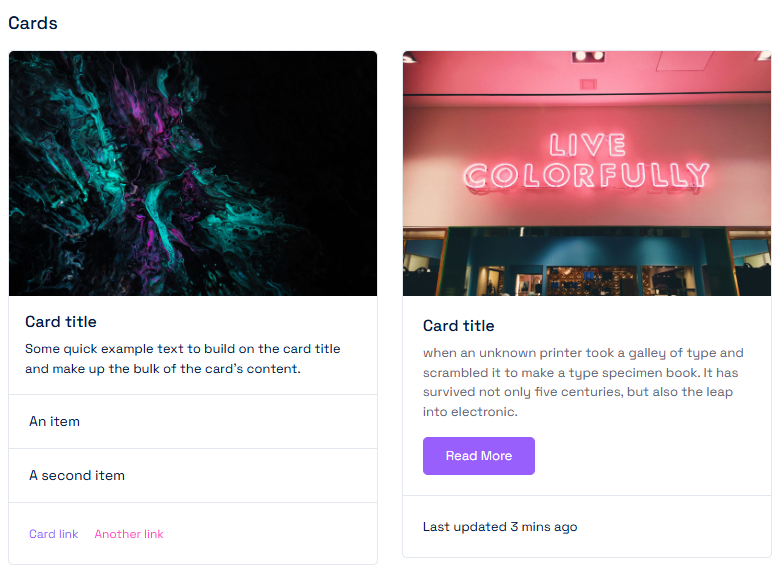
React Bootstrap Cards are versatile, customizable components for displaying content in a flexible, structured layout. They integrate Bootstrap’s card system with React, allowing you to create various types of content containers with options for images, headers, footers, and more, making them ideal for building rich, responsive UI elements.
React
Breadcrumb :
React Bootstrap Breadcrumb is a navigation component that displays a series of links to help users understand their location within a hierarchical structure. It seamlessly integrates with React Bootstrap’s breadcrumb styling, offering customizable options for separators, active links, and responsive behavior in React applications.

React
Dropdown :
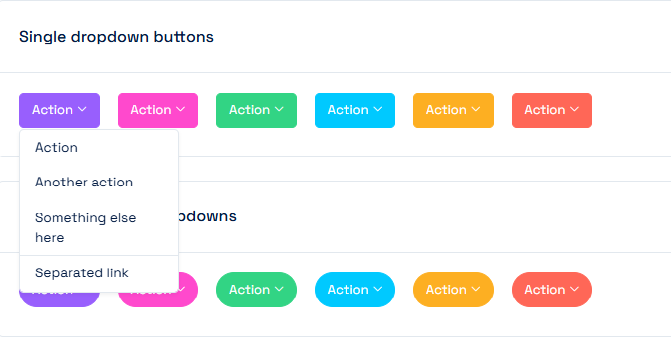
React Bootstrap Dropdown is a component that provides a simple way to create dropdown menus in React applications, following React Bootstrap's design conventions. It supports various options like single or multi-level menus, alignment, and customization of triggers (e.g., buttons or links), making it easy to build responsive, interactive dropdowns with minimal effort.
React
React
Tooltips :
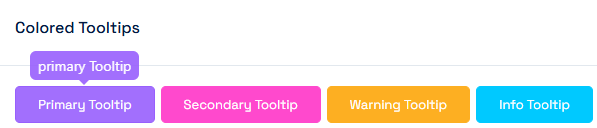
React Bootstrap Tooltips are small, customizable pop-up elements that provide additional information when users hover over or focus on an element. Built on React Bootstrap’s tooltip system, they offer easy integration in React applications, supporting various customization options like positioning, trigger events, and animations for a better user experience
React
React
Popovers :
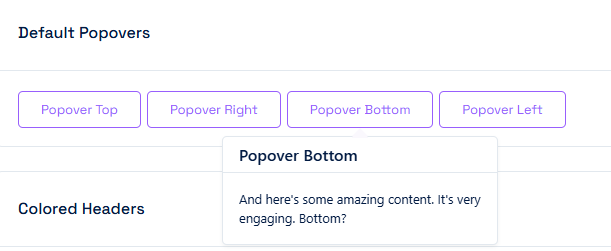
React Bootstrap Popovers are interactive components that display additional content or information when users click or hover over an element. Built on React Bootstrap’s popover system, they offer easy integration in React applications, with support for customizable content, placement, and triggers, allowing you to enhance the user interface with rich, contextual overlays.
React
React
Progress :
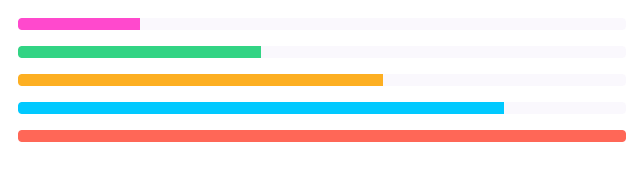
React Bootstrap Progress is a component that allows you to display progress bars in React applications, indicating the completion status of tasks or operations. It integrates seamlessly with React Bootstrap’s progress bar styles, supporting features like custom labels, striped animations, and varying bar colors for easy customization and responsiveness.
React
React
export const progressdata = [
    {id:1, data:0},
    {id:2, data:25},
    {id:3, data:50},
    {id:4, data:75},
    {id:5, data:100},
    ]
List Group :
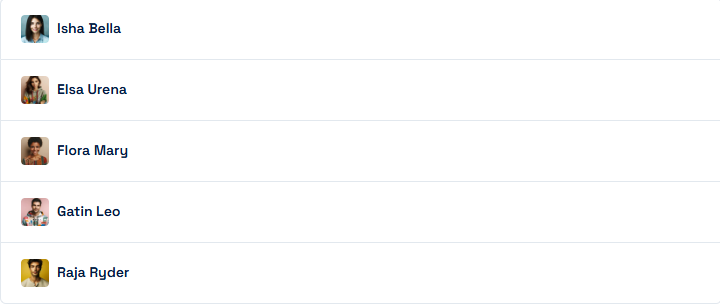
React Bootstrap ListGroup is a component for creating lists of items with consistent styling and behavior, using Bootstrap's list group system. It supports features like custom item content, active states, badges, and links, making it easy to build interactive and organized lists in React applications with full customization options.
React
React
Toast :
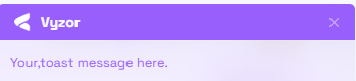
React Bootstrap Toast is a component for displaying lightweight, non-blocking notifications or messages in React applications. It integrates with React Bootstrap’s toast system, offering features like auto-dismiss, customizable timing, and different styling options for success, error, or info messages, making it easy to provide feedback to users in a clean and responsive way.
React
Accordions :
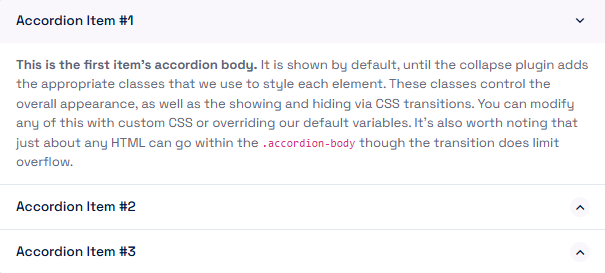
React Bootstrap Accordion is a component that allows you to display collapsible content panels in a stack, ideal for organizing large amounts of content in a compact, interactive layout. It integrates with React Bootstrap’s accordion system, supporting features like multiple or single panel expansion, custom styling, and smooth animations, making it easy to create dynamic, space-efficient UIs in React applications.
React
React
Carousel :
React Bootstrap Carousel is a component for creating responsive, interactive image sliders or carousels in React applications. It integrates seamlessly with React Bootstrap’s carousel system, offering features like slide transitions, controls, indicators, and automatic cycling, allowing you to display a series of content in an engaging and user-friendly way.
React
React
React-leaflet Maps :
Leaflet Maps is a modern javascript maps plugin..
React
React
css
Plugin link
https://react-leaflet.js.org/Reference Link
https://www.npmjs.com/package/react-leafletPigeon Maps :
Pigeon Maps is a modern javascript maps plugin..
React
React
Plugin link
https://pigeon-maps.js.org/Reference Link
https://www.npmjs.com/package/pigeon-mapsAdditional Plugins Included :
The following plugins have also been included, apart from the ones already listed in the above sections