



Introduction
Yzen - MudBlazor Web App Server Premium Admin & Dashboard Template
Yzen - MudBlazor Web App Server Premium Admin Template, With these template formats, it's very easy to create a presence and grab someone's attention around the web page Because the template is built using razor, C#, CSS3, MudBlazor framework and with Sass. So please before you start working with the template take a quick look on the documentation so that you can easily built your website. If You Love Our Template Design Please don't forgot to rate it. Thank you so much! 😊
Support and Updates:
When you purchase Yzen, you gain access to free future updates to ensure your template remains up-to-date. Plus, our support team is always ready to assist with any questions.
Dependencies for Yzen
- .NET 10.0.103 SDK
- Visual Studio Code or Visual Studio 2026
- C# for Visual Studio Code
- MudBlazor : 9.0.0
- Sass
- AspNetCore.SassCompiler : 1.97.1
- Node : 22.18.0
- NPM : 10.8.1
What Do You Get with the Yzen:
Yzen provides all necessary Razor, CSS, SCSS, JS files, along with detailed Documentation to help you easily customize and implement the template.
Yzen Compatibility with Popular Browsers:
Yzen is fully compatible with major browsers, ensuring a seamless user experience across Chrome, Firefox, Safari, Edge, and Opera.
Blazor Folder Structure
- Start by unzipping the project folder that you received from us.
- Go to the "Yzen\Components Layout directory within the project folder, where you'll find MainLayout.razor, LandingLayout.razor, MainHeader.razor and NavMenu.razor files etc..
- Go to the "Yzen\Components Pages directory within the project folder, where you'll find over 13 + folders and 170 + .razor files.
- The MainLayout.razor file serves as the base for all razor pages.
- The CustomLayout.razor file is the base for authentication pages such as Create-password-cover.razor, Reset-password-cover.razor, Two-step-verification-basic.razor, Error401.razor, Error500.razor, and Under-maintenance.razor, etc.
- The LandingLayout.razor file is the base for the Landing.razor page.
Installation Process of .NET SDK
Step 1: Visit the official .NET SDK download page.
Step 2: Click on the Download .NET SDK button.
Step 3: Run the installer to install the SDK on your system.
How to Run the Blazor Core Development Server
Using Visual Studio Code
- Unzip the project folder you received.
- Open the project folder in Visual Studio Code.
- Open a terminal and navigate to your project directory:
cd /path-to-your-projectThen run the development server:
Command
                                            dotnet build
                                            dotnet watch run
Using Visual Studio
- Unzip the project folder.
- Open the
.slnfile. - Press
F5to run the application.
Purpose of a Starter Kit
Introduction to the MudBlazor Starter Kit:
The MudBlazor starterkit is a resource that helps developers kickstart their MudBlazor web development projects by providing a preconfigured and ready-to-use template. It aims to simplify the initial setup and provide a foundation for building MudBlazor Framework-based websites or applications.
Purpose of the MudBlazor Starter Kit:
The purpose of the MudBlazor starter kit is to save developers time and effort by offering a set of prebuilt files and configurations commonly used in MudBlazor projects. Instead of starting from scratch, developers can leverage the starter kit to quickly set up a project structure that adheres to best practices and industry standards.
Benefits of Using the MudBlazor Starter Kit:
The starter kit eliminates the need to set up the basic project structure manually. It provides a well-organized file and folder structure, including commonly used directories for separating code, templates, assets, and configuration files. This allows developers to focus more on implementing business logic rather than spending time on initial setup.
Starterkit Overview
You can use the Starterkit if you are creating a new project. It will be time-consuming to use the full admin version for a new project as Yzen have more than 175 pages.
We have provided all the pre-build layouts like Sidemenu, Header, footer and blank pages etc in the Starterkit.
For further information or support regarding the template, please contact us using the provided link: https://support.spruko.com/
- Take a quick look at the folder structure of the "Starterkit."
- Integration of your customized razor pages becomes easy when using the "Starterkit."
- The "Starterkit" provides all the layout components, related assets, and plugins.
- To explore the contents of the "Starterkit," unzip the project folder received after purchase. Navigate to the following paths:
- Example: C:/projectname/Components/Layout- This folder contains files such as MainLayout.razor,NavMenu.razor, MainHeader.razor, Footer.razor, Modal.razor and Switcher.razor files.
- Example: C:/projectname/Pages/- This folder contains files such as NotFound.razor, files and etc..,.
SCSS Compilation with SassCompiler
Yzen uses AspNetCore.SassCompiler to compile SCSS files into CSS as part of the ASP.NET Core application lifecycle. This ensures styles are always generated automatically and stay in sync with your SCSS source files.
Installation
Install the AspNetCore.SassCompiler NuGet package to enable SCSS compilation. You can install it using any of the following methods:
-
Package Manager Console:
Install-Package AspNetCore.SassCompiler -
dotnet CLI:
dotnet add package AspNetCore.SassCompiler - PackageReference:
<PackageReference Include="AspNetCore.SassCompiler" Version="1.97.1" />
How it Works
SCSS files located in wwwroot/assets/scss are compiled into CSS
and written to wwwroot/assets/css.
Configuration
The Sass compiler is configured using sasscompiler.json:
    {
    "Source": "wwwroot/assets/scss",
    "Target": "wwwroot/assets/css",
    "Arguments": "--no-source-map --error-css --style=expanded"
    }
Live CSS Changes (Development Mode)
To enable live SCSS-to-CSS recompilation during development,
the Sass compiler is registered in the application startup Program.cs:
        if (builder.Environment.IsDevelopment())
        {
            builder.Services.AddSassCompiler();
        }
When enabled, any changes made to SCSS files are automatically recompiled at runtime, allowing CSS updates to reflect immediately without restarting the application.
Key Benefits
- Instant SCSS-to-CSS recompilation during development
- No manual build or watch commands required
- Fully integrated with ASP.NET Core
- Works seamlessly with MSBuild and PostCSS pipeline
Note:
Initial CSS files are generated by running dotnet build,
Run dotnet build once to generate CSS files if they do not exist in wwwroot/assets.
MSBuild Based Asset Pipeline
Yzen uses MSBuild targets to manage frontend assets in a structured and automated way. All tasks are executed as part of the standard ASP.NET Core build lifecycle.
This approach avoids introducing a separate JavaScript build system (such as esbuild or Gulp) and keeps asset processing fully aligned with the .NET build process.
Pipeline Responsibilities
- Ensures Node.js dependencies (node_modules) are installed
- Resolves and copies libs from
node_modules - Processes CSS using PostCSS
Why MSBuild?
MSBuild is used as the single orchestration layer for frontend assets to ensure consistency across development, CI/CD, and production builds.
- Runs automatically during
dotnet build - No separate frontend build commands required
- Works consistently across local and server environments
- Avoids duplicate or out-of-sync build pipelines
Automatic npm Dependency Handling
The build pipeline requires Node.js dependencies to be available in node_modules
because frontend assets (such as copying npm libraries, SCSS processing, and PostCSS transforms)
are executed during dotnet build.
To support both local development and CI environments, an MSBuild target named
HandleNpm ensures that dependencies are available before the build continues.
<PropertyGroup>
  <!-- Detect CI environment (Azure DevOps, or generic CI=true) -->
  <IsCI Condition="'$(CI)' == 'true' Or '$(TF_BUILD)' == 'true'">true</IsCI>
</PropertyGroup>

<Target Name="HandleNpm" BeforeTargets="Build">

  <!-- CI behavior: CI pipelines MUST explicitly run 'npm ci' before 'dotnet build'.
  This ensures deterministic, reproducible builds. -->
  <Error Condition="'$(IsCI)' == 'true' And !Exists('node_modules')"
         Text="node_modules not found. Run 'npm ci' in the CI pipeline before building." />

  <!-- Local development behavior: If node_modules is missing, dependencies are installed automatically.
    This runs only once and will not repeat if node_modules already exists. -->
  <Exec Command="npm install --no-audit --no-fund"
        Condition="'$(IsCI)' != 'true' And !Exists('node_modules')" />

</Target>
This approach ensures:
- Fast local development (automatically installs node_modules if not exists.)
- Strict CI reproducibility
- Reliable frontend asset processing during
dotnet build
Npm Package libraries Management
-
npm packages are managed through
package.json. You can install a package usingnpm install <package-name>, ensuring consistent dependency versions across all environments. -
When
dotnet buildis executed, MSBuild copies the required package libs fromnode_modulestowwwroot/assets/libs, making them available for runtime use.
If you want new npm plugin, Install it using command npm install <package-name>, stop the server, then run dotnet build. The configured MSBuild targets will automatically copy the package libs from node_modules to wwwroot/assets/libs.
    <Target Name="CopyVendorAssets" AfterTargets="Build">
    <Message Importance="high"
            Text="Auto-resolving and copying vendor assets..." />

    <Copy SourceFiles="@(AllFiles)"
            DestinationFolder="wwwroot\assets\libs\%(Folder)\%(RecursiveDir)"
            SkipUnchangedFiles="true" />
    </Target>
The pipeline intelligently detects whether a package exposes a dist, min, umd
directory and copies optimized files when available.
If no dist folder exists, the package contents are copied instead.
PostCSS Processing
After SCSS to CSS compilation by SassCompiler, CSS files are post-processed using PostCSS. PostCSS is used as a lightweight transformation step rather than a full bundling solution.
The PostCSS configuration is defined in postcss.config.js:
    module.exports = {
        plugins: [
            require('postcss-import'),
            require('autoprefixer'),
        ]
    };
-
postcss-import – enables modular CSS with
@importand bundles it into one file. - Autoprefixer – automatically adds required CSS prefixes to ensure cross-browser compatibility.
    <Target Name="MinifyAndPrefix" AfterTargets="Build">
    <Message Importance="high"
            Text="Post-processing CSS: Autoprefixing and Minifying..." />

    <Exec Command="npx postcss wwwroot/assets/css/icons.css
            -o wwwroot/assets/css/icons.css" />

    <Exec Command="npx postcss wwwroot/assets/css/styles.css
            -o wwwroot/assets/css/styles.css" />

    <Exec Command="npx postcss wwwroot/assets/css/icons.css
            -o wwwroot/assets/css/icons.min.css --use cssnano" />

    <Exec Command="npx postcss wwwroot/assets/css/styles.css
            -o wwwroot/assets/css/styles.min.css --use cssnano" />
    </Target>
- cssnano – used only for generating minified production CSS files
When you run dotnet build command, the following actions take place:
- npm dependencies are installed automatically (if missing)
- npm package libs are copied to
wwwroot/assets/libsfromnode_modulesfolder - CSS is autoprefixed and minified
All frontend asset tasks are handled automatically by MSBuild, keeping the asset pipeline simple, predictable, and production-ready.
Overall Project Workflow
The project uses SassCompiler to compile SCSS files into CSS, and MSBuild targets to copy npm package libraries from node_modules into wwwroot/assets/libs.
PostCSS is used for autoprefixing and minification of the generated CSS.
Recommended Development Flow
-
Always run
dotnet buildfirst, then start the application usingdotnet watch run. -
Although
dotnet watch runperforms a build before starting, it may run an incremental build and some MSBuild targets (such as copying libs) may not execute fully. -
Therefore, if
wwwroot/assets/libsis missing, the project may start successfully, but some components can fail with missing library errors because the required libs are not copied fromnode_modules.
During development, SassCompiler watches SCSS changes automatically, so you do not need to manually recompile or restart the server
because we have registered the Sass Compiler in the application startup Program.cs:
    if (builder.Environment.IsDevelopment())
    {
        builder.Services.AddSassCompiler();
    }
When enabled, any changes made to SCSS files are automatically recompiled at runtime, allowing CSS updates to reflect immediately without restarting the application.
Adding a New npm Package
When adding a new npm package, install it using npm install <package-name>, stop the server,
then run dotnet build. The configured MSBuild targets will automatically copy the package libs from node_modules to wwwroot/assets/libs.
FAQ'S
Step 1:
Go To style.scss (wwwroot/assets/scss/styles.scss )
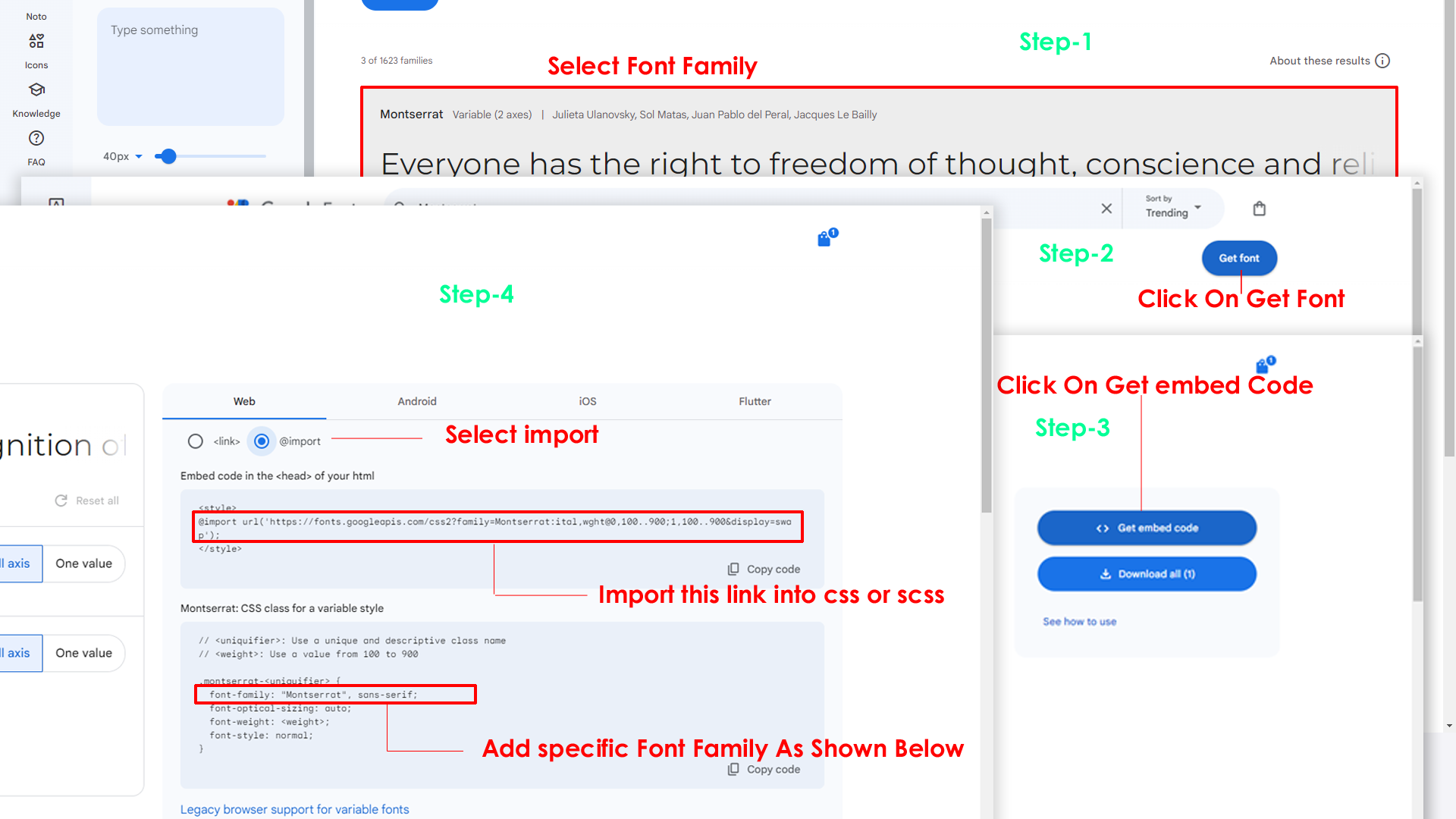
if you want to change another font-family Go to the site Google Fonts And Select One font Family and import in to styles.scss file
How to Select font Family
Step 2:
And paste Your Selected font-family in style.scss

Step 3:
And add the Your Selected font-family in _variables.scss(static/assets/scss/_variables.scss)
code
--default-font-family: "Space Grotesk", sans-serif;By default menu icons are phosphoricons if you want to change icons please follow below steps
Step :
To change Menu icons, open MenuData.Service.cs file Path:Services/MenuDataService.cs and go through
MainMenuItems you can find the svg property,
in the place of phosphoricons of you can replace it with the required icon, Example
as shown in below
To Add the New link element, open MenuData.Service.cs page Services\MenuData.Service.cs and go through the object where you are want to place the new menu element.
To Add the New menu element, open MenuData.Service.cs page Services\MenuData.Service.cs and go through the object where you are want to place the new menu element.
To Remove the link/sub element, open MenuData.Service.cs page Services\MenuData.Service.cs and go through the object which you are intended to remove.
Go To "wwwroot/assets/images/brand-logos" folder and replace
your
logo with Previous Logos within in image size.
note: Please don't increase logo sizes. Replace your logo within
given
image size. otherwise the logo will not fit in particular place it
disturbs the template design.
To remove switcher Go to root path: Components/Layout/ open "MainHeader.razor" in that file, then remove below mentioned code.
To remove switcher Go to root path: Components/Layout/ open "LandingHeader.razor" in that file, then remove below mentioned code.
Please follow the below steps to change Primary Color
Step 1 :
To change Primary Color you have to open _variables.scss file and replace what color you want as shown in below
Rootpath : _variables.scss (wwwroot/assets/scss/_variables.scss )

Please follow the below steps to change Dark body Color
Step 1 :
Make sure the theme is set completely to dark mode by adding the following attributes to the html tag data-theme-mode="dark" data-header-styles="dark" data-menu-styles="dark"
Step 2 :
To change Dark body Color you have to open _variables.scss file and replace what color you want as shown in below
Rootpath : _variables.scss (wwwroot/assets/scss/_variables.scss )

Step 3 :
Also Change the following variable colors to the desired theme background accordingly in [data-theme-mode="dark"]
--light-rgb : --form-control-bg : --input-border : --gray-3 :Credit's
Icons Credit
| Icons | References |
|---|---|
| Bootstrap Icons | https://icons.getbootstrap.com/ |
| Remix Icons | https://remixicon.com/ |
| Feather Icons | https://feathericons.com/ |
| Tabler Icons | https://tabler-icons.io/ |
| Line Awesome Icons | https://icons8.com/line-awesome |
| Boxicons | https://boxicons.com/ |
| Material Icons | https://fonts.google.com/icons?icon.set=Material+Icons |
Images Credit
| Images | References |
|---|---|
| Vecteezy | https://www.vecteezy.com/ |
| Iconscout | https://iconscout.com/ |
| Unsplash | https://unsplash.com/ |
Fonts Credit
| Font | References |
|---|---|
| Google Fonts | https://fonts.google.com/ |
Sidemenu Icons
| Icon | References |
|---|---|
| phosphor Icons | https://phosphoricons.com/ |
Switcher styles
StateService.cs
    public string ColorTheme { get; set; } = "light";                   // light, dark
    public string Direction { get; set; } = "ltr";                      // ltr, rtl
    public string NavigationStyles { get; set; } = "vertical";          // vertical, horizontal
    public string MenuStyles { get; set; } = "";                        // menu-click, menu-hover, icon-click, icon-hover
    public string LayoutStyles { get; set; } = "default-menu";          // doublemenu, detached, icon-overlay, icontext-menu, closed-menu, default-menu
    public string PageStyles { get; set; } = "regular";                 // regular, classic, modern
    public string WidthStyles { get; set; } = "fullwidth";              // default, fullwidth, boxed
    public string MenuPosition { get; set; } = "fixed";                 // fixed, scrollable
    public string HeaderPosition { get; set; } = "fixed";               // fixed, scrollable
    public string MenuColor { get; set; } = "dark";                     // light, dark, color, gradient, transparent
    public string HeaderColor { get; set; } = "dark";                  // light, dark, color, gradient, transparent
    public string ThemePrimary { get; set; } = "";                      // '106, 91, 204', '100, 149, 237', '0, 123, 167', '10, 180, 255', '46, 81, 145'
    public string ThemeBackground { get; set; } = "";                   //make sure to add rgb valies like example :- '49, 63, 141' and also same for ThemeBackground1
    public string ThemeBackground1 { get; set; } = "";
    public string BackgroundImage { get; set; } = "";                   // bgimg1, bgimg2, bgimg3, bgimg4, bgimg5
Nudget Package Included :
If you need a new NuGet package, install it using the command: "dotnet add package new-package-name" . The package has now been installed successfully and will be referenced in the .csproj file.
NPM Plugins & Reference Links
All plugins runs through npm.
If you want new npm plugin Install it using command npm install <package-name>, stop the server,
then run dotnet build. The configured MSBuild targets will automatically copy the package libs from node_modules to wwwroot/assets/libs.